
There are Western painters who give you drama first. Monument, canyon, declaration, grandeur. The horizon arrives with a trumpet. John Hafen did something quieter and, in the long run, perhaps more difficult. He painted light as condition rather than spectacle. He understood that the West is not only a place of scale but a place of atmosphere: haze settling over foothills, evening touching stone, a building turning golden for a moment before sinking back into plainness. He painted not just what the eye sees, but what the air is doing to what the eye sees.
That is why Hafen matters for Idaho, even if Idaho was not his singular subject. The Intermountain West is a family of places linked by altitude, dryness, long distances, and a peculiar clarity that is never as simple as it first appears. Idaho belongs fully to that family. So does Hafen. He helps provide a visual language for the region’s softer truths: that light here can be tender without being weak, solemn without being theatrical, and spiritual without resorting to cliché.
Born in Switzerland in 1856 and raised in the American West, Hafen developed as an artist at a time when questions of region, faith, beauty, and seriousness still felt open. He studied, traveled, and absorbed European influences, but he never surrendered the Western eye. That matters. Some painters return from Europe determined to prove that they have escaped provincialism. Hafen came back with a sharpened ability to see his own world. He did not treat Western landscape as an embarrassment to be civilized. He treated it as something worthy of disciplined attention.
What survives best in his reputation is not mere prettiness, though his paintings can be beautiful in obvious ways. It is his seriousness about atmosphere. His work often seems to pause at the hour when one kind of seeing gives way to another: afternoon into evening, brightness into reflection, surface into mood. That is a painterly intelligence Idaho readers will recognize. This is a state where weather is not just weather. It is identity. Morning at an alpine lake, twilight on a downtown building, winter light against a lodge window, the quick bronze hush before night overtakes the mountains—these are not decorative extras here. They are part of how place becomes consciousness.
John Hafen painted the West not as a shout, but as a settling of light over matter.
Why Idaho Needs a Wider West
One temptation in state-based cultural journalism is to insist that everything worthy must be native, local, or neatly contained within borders. That is understandable. States are always trying to define themselves. But culture does not obey cartography so politely. The most interesting Idaho is often the Idaho that recognizes its affinities: with Montana, with Utah, with Wyoming, with the old regional corridors of rail, migration, religion, mining, ranching, and mountain weather. Hafen belongs to that broader conversation. He is not Idaho’s possession. He is one of the artists who help explain the visual civilization to which Idaho belongs.
That distinction is useful. It lets us think beyond boosterism. One need not pretend that Hafen was “really” an Idaho artist in order to claim his relevance. In fact, his value grows when we resist that simplification. He offers Idaho something more sophisticated than ownership: a regional inheritance. He helps show that the West is not only geology or conquest or masculine bravado. It is also sensitivity to intervals, to shifting light, to the emotional temperature of open space.
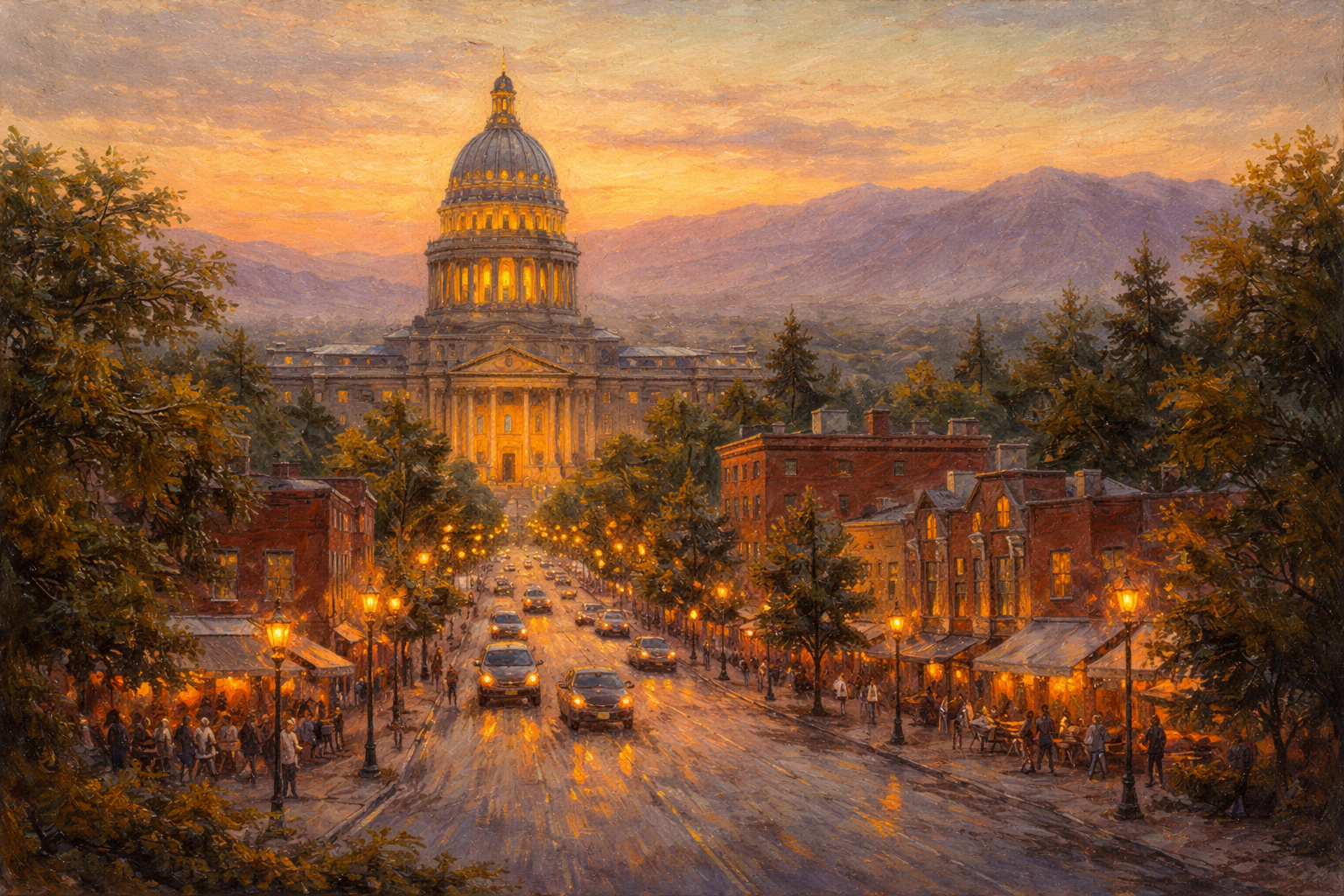
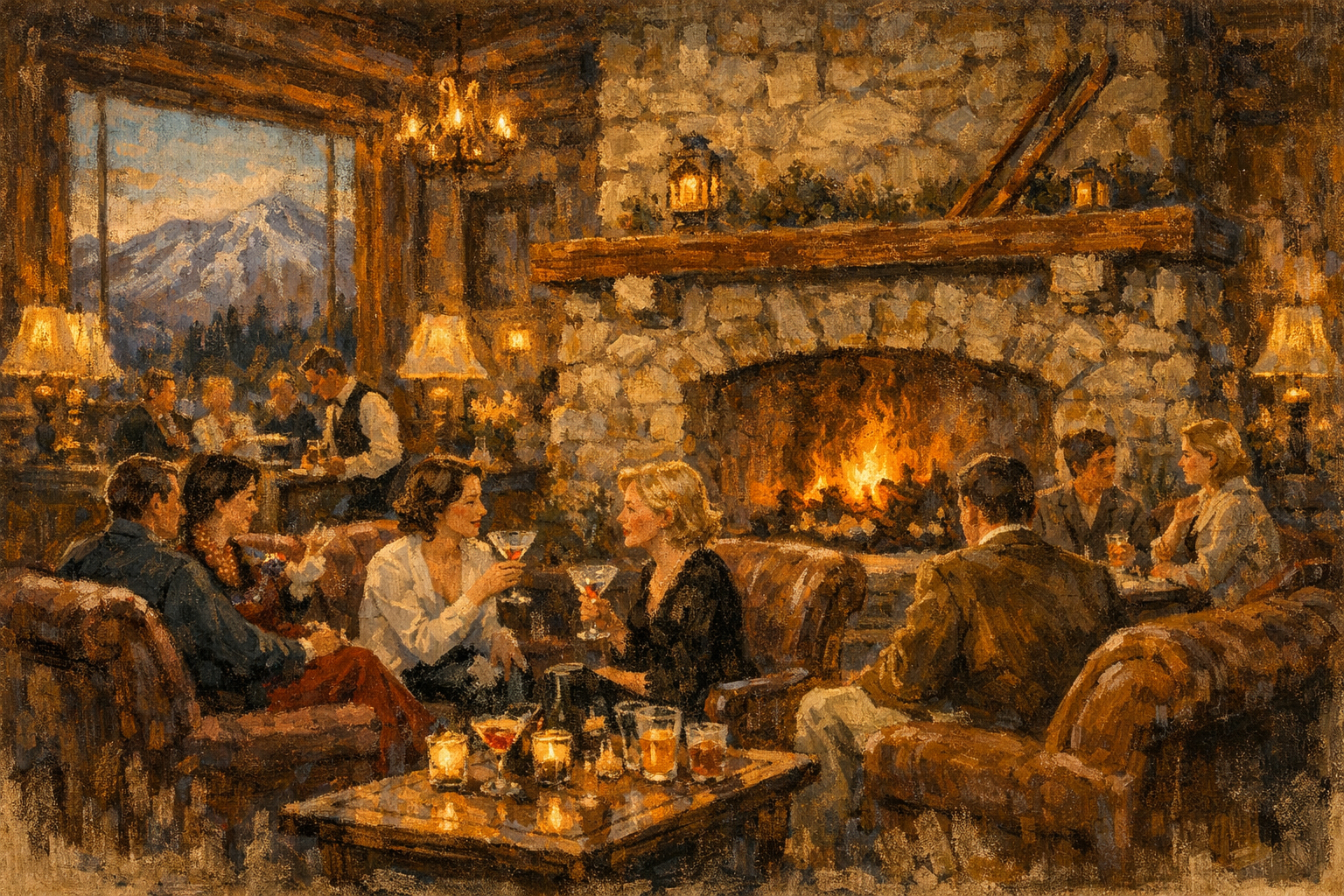
Look, for example, at what happens in images inspired by his manner. A state capitol becomes less an object than an event in air. A lodge interior becomes less a luxury scene than a study in warmth, shelter, and dusk. The lesson is not that Hafen can be copied, but that he teaches a way of seeing. The world is not dead matter waiting to be described. It is matter continually revised by light. That is an artistic truth, but it is also a regional truth. Idaho knows it every day.
The Soft Authority of Evening
Hafen’s particular gift may be hardest to describe precisely because it is a gift of modulation. He does not batter the eye. He persuades it. He understands the authority of restraint. In an American culture that often mistakes volume for conviction, that feels newly relevant. He shows that seriousness need not arrive as heaviness. It can arrive as tonal control, as patience, as a refusal to flatten a place into symbols before one has really looked at it.
That refusal matters in Idaho, where beauty is often marketed too quickly. Mountains become icons. Lakes become escapes. Small cities become “vibes.” What is harder to preserve is the moral complexity of a place—the way a landscape can be at once inviting and austere, lucid and lonely, hospitable and indifferent. Hafen’s Western light retains that complexity. It warms without sentimentalizing. It clarifies without hardening. It gives the world contour but not simplification.
Even in works and scenes that feel serene, there is often a tremor beneath the surface: a sense that stillness is not empty but charged. Idaho has that quality too. It is one reason the state can feel so distinct to people who truly notice it. Silence here is not the absence of meaning. It is one of the forms meaning takes. Hafen understood something like that. His paintings often seem to say that calm is not a lack of drama. Calm is where drama has gone inward.
Light, Faith, and Discipline
Hafen’s work has often been discussed in relation to faith, and that is not incidental. But what matters most, at least from an editorial distance, is not whether one shares the doctrinal framework around him. It is that he painted with spiritual seriousness. He approached landscape and built form alike as if they were capable of bearing more than appearance. That seriousness gave his work gravity. He was not painting décor for the eye. He was painting a world capable of significance.
There is a disciplined humility in that. He did not use nature merely as pretext for ego. He did not confuse self-expression with self-display. The painter, in his work, is not absent, but neither is he shouting over the scene. That balance is difficult and rare. It is one reason Hafen feels useful now, when so much visual culture is either aggressively branded or aggressively disposable. He reminds us that attention itself can be a moral act.
Idaho, too, benefits from that reminder. A state like this can be trivialized in two opposite ways: by condescension from outside, or by easy pride from within. The better path is attentiveness. Look harder. See more accurately. Allow mood, weather, and texture to matter. That is the path Hafen models. He asks us to become better witnesses to place.
Beyond Idaho, Within Idaho
The title of this piece matters. Western light beyond Idaho. Not because Idaho is insufficient, but because Idaho is enlarged by what exceeds it. States are most interesting when they know they are permeable—when they recognize that their identity is shaped not only by what is enclosed, but by what passes through. Light is one of those things. Influence is another. Hafen’s relevance to Idaho lives precisely in that crossing. He belongs to a wider West, and Idaho belongs to that wider West too.
That is why the Hafen-inflected images in this collection make sense. Boise at evening. Sun Valley by firelight. Scenes of warmth and transition. They are not “about” historical accuracy in a narrow sense. They are about interpretive fitness. His mode of seeing suits them. The pairing works because Hafen understood atmosphere as destiny. He knew that how a place receives light is part of what a place is.
There are more overtly “Idaho” painters to discuss, and we should discuss them. There are native sons, pioneer figures, and local originals whose claims on the state are more direct. But cultural maturity means knowing when indirect relevance is just as valuable. Hafen’s work gives Idaho something subtle and necessary: an elevated visual tone. He helps move the conversation beyond scenery and toward sensibility.
What Remains
What remains of John Hafen, finally, is not simply a set of paintings. It is a standard of regard. He suggests that the West deserves to be painted with delicacy as well as force, with feeling as well as confidence, with atmosphere as well as outline. He makes room for a gentler grandeur than American mythology usually permits. That is no small thing.
For Idaho, the lesson is almost editorial. We do not need to shout our beauty. We do not need to force significance through slogans. We can trust the evening light on the capitol. We can trust the warmth of a lodge interior against snow. We can trust the hush that arrives when landscape becomes mood and mood becomes thought. Hafen knew how to trust those things. That is why, beyond Idaho, he still belongs within it.