
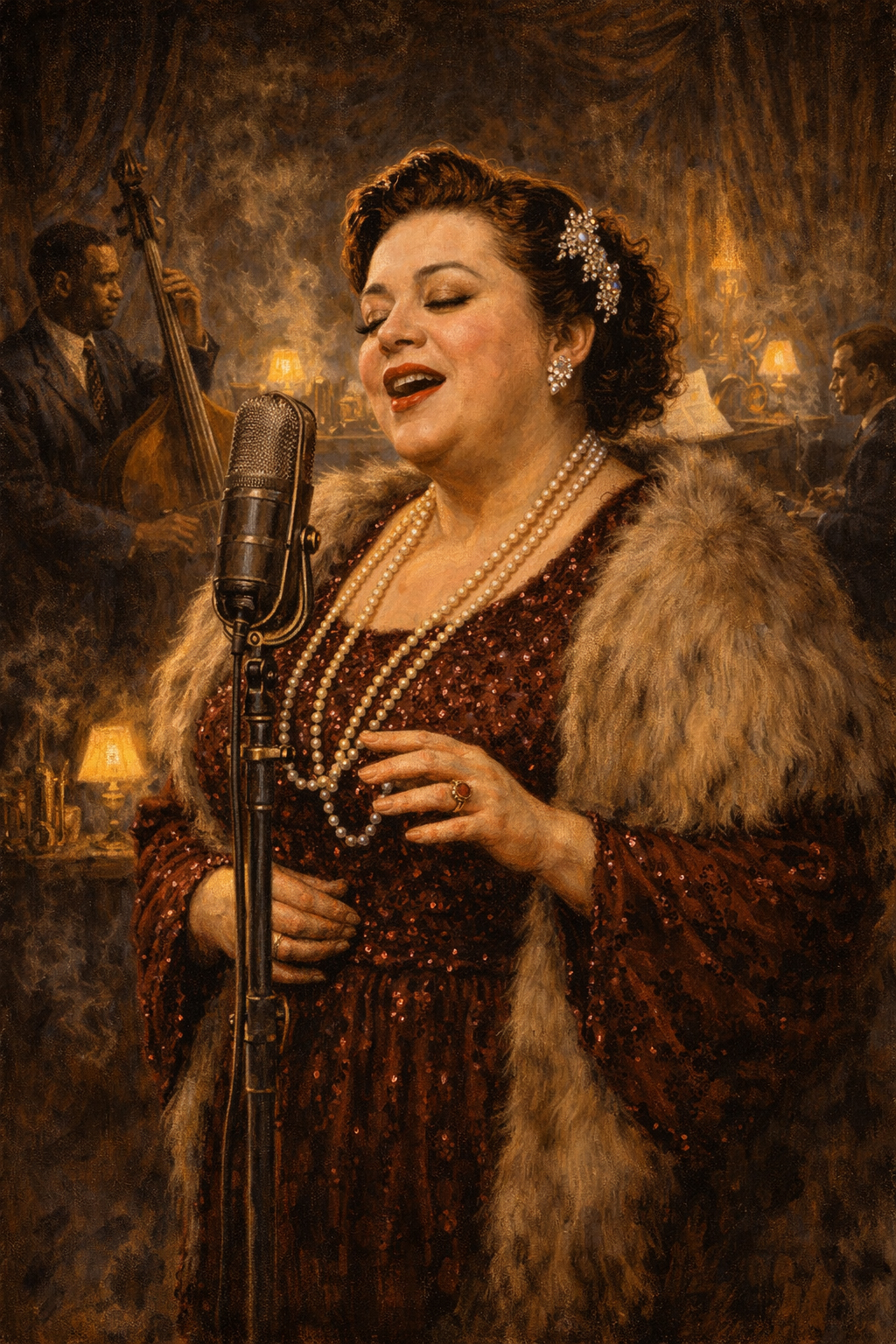
There are singers who overwhelm by volume, and there are singers who endure because they know how to hold a line just inside the point of strain. Mildred Bailey belonged to the second class. She sang with poise. That word can sound too polite, too minor, until one remembers how difficult poise really is. It requires control without stiffness, feeling without spillage, intimacy without self-pity. Bailey’s voice had that rare balance. It could seem conversational and inevitable while remaining unmistakably shaped by intelligence.
Her Idaho connection matters precisely because it complicates the usual geography of American jazz memory. The canonical story tends to move eastward and urbanward very quickly, as though the nation’s musical sophistication sprang fully formed from clubs, bandstands, radios, and city streets. Bailey reminds us that origins are often stranger and wider than the polished narrative admits. She was born in 1907 and raised within a world that connected Idaho, the Inland Northwest, family music, regional movement, and Indigenous life to the larger American bloodstream. Before the stage lights and the records, there was the Coeur d’Alene world.
That beginning does not explain her talent in some simplistic way. Talent explains itself badly enough. But origins shape the cast of a sensibility. Bailey’s voice would later sound worldly, controlled, witty, and emotionally literate. Yet there is something useful in remembering that one of the great female jazz voices did not emerge from an already canonized corridor. She came from a place many national histories still misread as peripheral. Idaho, in her story, is not provincial scenery. It is part of the American source.
Mildred Bailey made refinement sound less like polish than like command.
A Different Kind of Power
Bailey is sometimes described too softly. This happens often to women whose strength traveled through elegance rather than blunt display. One hears words like “sweet,” “delicate,” “warm,” and while none of these are wholly false, they are insufficient. Sweetness can be a form of reduction. Bailey was not merely sweet. She was exact. Her phrasing had decision in it. She knew where to lean, where to release, where to imply rather than insist. The result was not fragility. It was control of atmosphere.
This matters because atmosphere is one of the hardest things to master in music. Technical command can be taught and measured more easily than tonal authority. Bailey possessed tonal authority. When she sang, the emotional weather of the room changed. Yet she achieved this without the grandstanding that often passes for force. Her style belonged to a higher order of confidence. She did not need to overstate herself because the line itself already carried intention.
Idaho, interestingly, has room for this sort of figure in its identity. The state is often narrated through harder forms of distinction: ruggedness, independence, invention, political stubbornness, mountain scale. Bailey adds another register. She reminds us that Idaho’s uniqueness is not only muscular or scenic. It can be tonal. It can appear in the form of taste, subtlety, and a refusal to confuse emotional intelligence with weakness.
The Reservation, the Region, the Nation
To say that Bailey was born on the Coeur d’Alene Reservation is not to turn biography into ornament. It is to place her correctly in the American story. The nation’s culture did not emerge from a single center and then spread outward. It was always more entangled than that: Indigenous, regional, migratory, improvised, shaped by rail lines and family networks and local music-making long before national fame ratified what mattered. Bailey’s life belongs to that richer, truer pattern.
The Inland Northwest is often left out of the glamorous version of American cultural history, as if the real drama happened elsewhere and the region merely sent people away. But departures are part of culture too. A person may carry a place into rooms that later forget where the force first began. In that sense, Mildred Bailey did what many important western figures do. She left the region physically while continuing to enlarge it symbolically. Her career said, in effect, that refinement did not require an eastern origin story in order to count as authentic.
There is something satisfying in that. Idaho is too often imagined as a place that must borrow distinction from elsewhere. Bailey reverses the direction of influence. She becomes evidence that the state has not only scenery to export, but sensibility.
The Jazz Problem of Memory
Jazz memory is uneven. Some names remain iconic because they fit the later mythology of genius and excess. Others slip into a more specialized reverence, admired by musicians, scholars, and serious listeners while losing mass visibility. Bailey belongs somewhere in the middle: too important to vanish, too subtle to remain as loudly memorialized as larger myths. That very subtlety, however, may be part of why she feels so modern now.
We live in a culture increasingly exhausted by overstatement. Loudness has become the default public setting, and in that environment Bailey’s art sounds newly instructive. She demonstrates that style need not be armor, that emotional clarity need not be exhibitionism, that one can be unmistakably present without turning every phrase into a plea for applause. Listening to her, even now, one hears a higher discipline of selfhood.
She sang as if restraint were not a limitation, but a finer instrument.
This makes her not only historically important but editorially useful for a magazine like The Idaho Identity. Bailey helps broaden the state’s self-image. She allows Idaho to sound more cultivated without becoming false, more national without becoming generic, more female without being reduced to sentiment. She offers evidence that distinction may come dressed in grace and still retain full force.
Elegance, Wit, and Emotional Precision
The truly great popular singers are not merely carriers of melody. They are interpreters of social intelligence. They know how a line sits inside conversation, flirtation, regret, irony, longing, and self-command. Bailey understood this. Her voice carried wit because it carried timing. It carried sadness without asking to be pitied. It carried tenderness without collapsing into vagueness. In all of this, she sounded grown.
That maturity is one reason she still matters. Much American performance, in every era, is pulled toward either innocence or damage. Bailey belonged to neither camp. She sounded composed. She sounded as though feeling had already passed through judgment and emerged clearer for it. That is a rare sound. It is also a distinguished one. The title of this feature is not ornamental. She really did make a sound of distinction.
To call it distinction is also to acknowledge the social charge of her art. Bailey was not only an individual voice. She was a challenge to the narrowness of who gets remembered as foundational, who gets to define sophistication, and what parts of the American map are allowed to produce cultural authority. The answer, in her case, was not supposed to be Idaho. And yet Idaho is part of the answer all the same.
Why She Belongs in Idaho’s Canon
Every state needs a more intelligent canon than the one tourism or schoolroom convenience would naturally assemble. It needs not just its politicians and inventors, but its tonal figures—the people who change how the state can be imagined. Bailey is one of those figures for Idaho. She does not simply add glamour or historical variety. She adds register. She makes Idaho sound less monolithic and more complete.
Think of the difference she introduces into the state’s human gallery. Beside Borah’s force, Bailey’s poise. Beside Farnsworth’s invention, Bailey’s interpretation. Beside wilderness and civic mythology, Bailey’s microphone and phrasing. The state becomes richer immediately. It acquires a subtler voice. It begins to seem not only scenic and independent, but musically literate, socially alert, and capable of elegance without borrowed apology.
This is one reason mature regional magazines matter. They can place a figure like Bailey exactly where she belongs: not in a token niche, not as a curiosity, but in the center of the state’s serious story. Idaho is not merely the place she came from before becoming important elsewhere. Idaho is part of what makes her presence in the American cultural record so interesting in the first place.
The Sound That Remains
What remains of Mildred Bailey now is not just a set of recordings, nor only a historical distinction such as being early, influential, or overlooked. What remains is a standard. She demonstrates a mode of American performance in which intelligence and feeling are not enemies, in which elegance can carry authority, and in which a woman’s voice can command a room without accepting the crude bargains performance often demands of it.
For Idaho, that should mean something. States are often proud of strength but less practiced at recognizing refinement as strength. Bailey asks for a broader definition. She invites Idaho to remember that distinction may sound like a held note, a turned phrase, a line delivered with calm exactness. She enlarges the state not through monumentality, but through tone.
Mildred Bailey and the sound of distinction: the phrase holds because she did. She made room for grace without surrendering force. She carried Idaho into the national imagination not as spectacle, but as style. And style, when it is this disciplined, this emotionally exact, this quietly commanding, deserves to be counted among the state’s highest forms of character.