
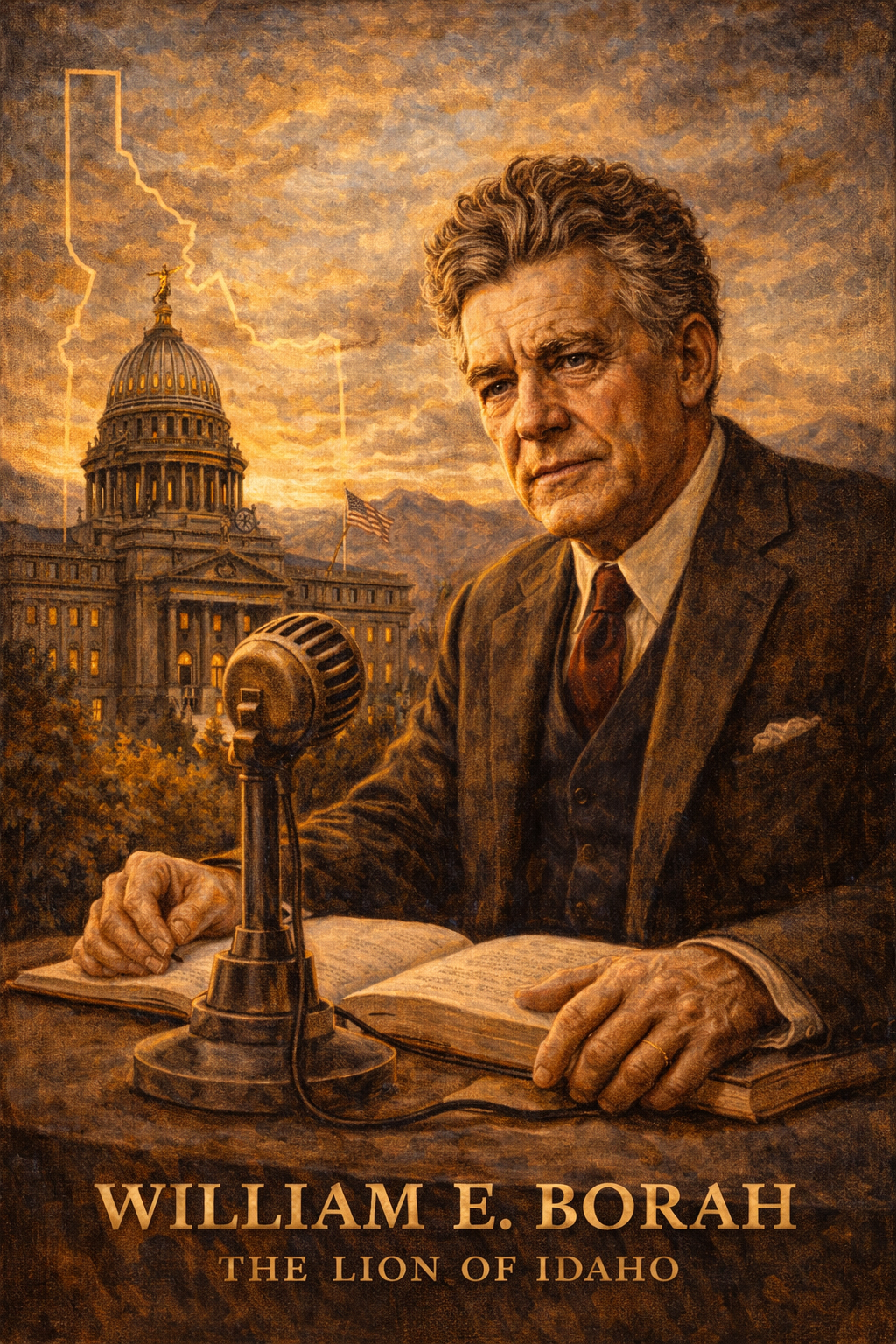
The nickname was almost inevitable. The Lion of Idaho. It sounds slightly overripe to modern ears, a relic of an age when public men were allowed to be cast as animals of force and bearing. Yet in Borah’s case it fit. He had size without bulk, drama without theatrical emptiness, and a speaking style that made ordinary legislators seem to be arguing over furniture while he was arguing over history. He did not merely hold opinions. He inhabited them at full height.
Borah was not born in Idaho. He was born in Illinois in 1865 and came west as a young lawyer, arriving in Boise in the early 1890s, when Idaho itself was still newly admitted to the Union and still trying to decide what kind of state it intended to become. That timing matters. Borah entered Idaho at a stage when ambition and instability were still closely linked. The place had not yet settled into self-description. It needed institutions, yes, but it also needed scale of personality. Young states often do. Borah supplied that scale in abundance.
It is tempting to describe him simply as an Idaho senator of national stature. That is true, but insufficient. Plenty of senators represent a state. Borah, at his height, seemed to project a state outward. He was one of those political figures whose presence does not remain inside procedural boundaries. He turned committee rooms and chamber debates into stages on which larger American questions—empire, war, national purpose, constitutional duty, international power—were asked in tones meant to be remembered. Idaho, through him, did not appear incidental. It appeared formidable.
Borah gave Idaho something every young state wants and very few receive: a voice in Washington that sounded like destiny rather than attendance.
The Art of Political Magnitude
To write about Borah now is to risk two opposite mistakes. One is antiquarian admiration: to praise the old orator merely because he belonged to an era when people spoke in rolling paragraphs and still believed public life should sound elevated. The other is condescension: to dismiss him as a grandiloquent relic, a man too convinced of his own importance to survive contemporary scrutiny. Neither is adequate. Borah deserves something harder and more interesting. He deserves to be treated as a political intelligence of genuine force whose contradictions are part of his significance, not an excuse to ignore him.
He was a Republican, but not the soft kind. He could be progressive and combative, suspicious of concentrated power at home yet resistant to foreign entanglements abroad. He made national headlines as an opponent of American entry into the League of Nations, and in that opposition he became not just an Idaho figure but a national symbol of a certain kind of American self-conception: sovereign, morally serious, unwilling to subordinate national judgment to international machinery. One need not fully admire that worldview to grasp its potency. Borah gave it eloquence.
Eloquence is not decoration in politics. At least it should not be. In Borah’s time, rhetoric still carried constitutional weight. A speech was not merely a clip or a device for social circulation. It was a serious instrument for assembling public meaning. Borah understood this, and he used language accordingly. He did not speak as though words were disposable wrappers around power. He spoke as though they were part of power itself. That is one reason he remains so magnetic in retrospect. The modern political class is often embarrassed by grandeur unless it can be made ironic. Borah had no such embarrassment.
Idaho and the Performance of Independence
What, precisely, made him so suitable to Idaho? Not merely that the state was western, young, and proud of its distance from older centers of authority. It was also that Idaho has always possessed a difficult, attractive streak of independence that can appear admirable or exasperating depending on the hour. Borah did not sand that edge down for national approval. He sharpened it. He embodied the idea that a man from Idaho might enter the capital not as a supplicant for relevance, but as a judge of the republic’s moral direction.
That posture mattered. It told the country something about Idaho, and it told Idaho something about itself. States are partly made by how they are represented at moments of national seriousness. Borah gave Idaho an image of confidence under pressure. He made it conceivable that the state’s role was not merely to furnish votes, minerals, scenery, or distance, but argument. A great many places are geographically distinctive. Far fewer develop a political personality strong enough to travel.
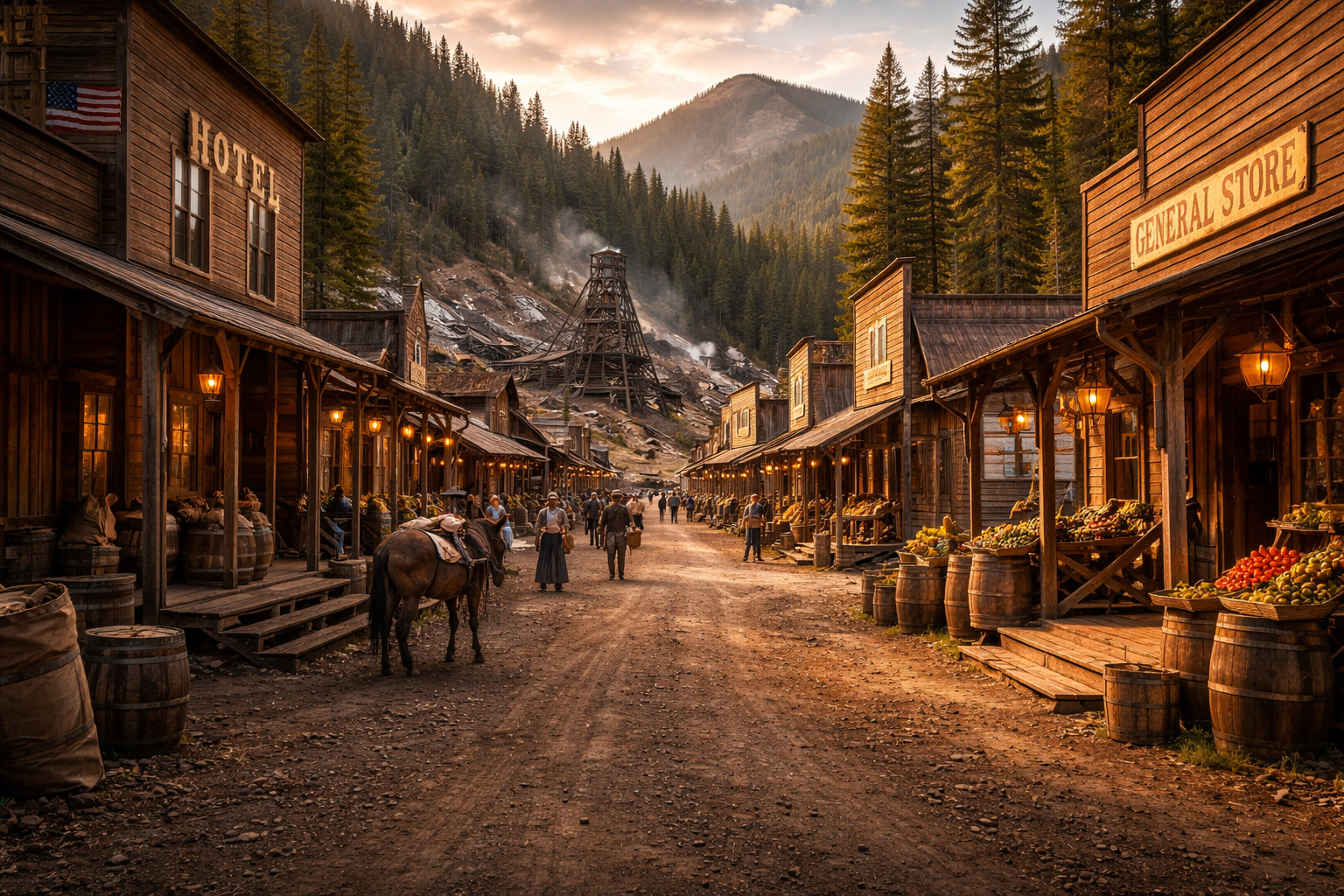
There is another point too. Young western states often needed men who could convert rawness into legitimacy. The frontier produced energy, conflict, appetite, and improvisation. But legitimacy required voice, and voice required discipline. Borah was disciplined in the old way: by reading, by law, by combativeness trained through formality. He did not civilize Idaho in the condescending sense. He dramatized its claim to seriousness. That is a subtler and more enduring achievement.
The Speaker as Statesman
The old Senate rewarded speech differently than the modern one does. It still believed, at least intermittently, that debate could elevate as well as delay. Borah thrived in that environment because he was made for it. His voice was famous, his bearing imposing, his confidence nearly architectural. He could be severe, but never trivial. He understood timing, emphasis, moral contrast. One suspects he loved the sound of his own argument, but this is not the cheap vanity it first appears to be. Great speakers often love argument because they believe public life deserves to be argued at full scale.
And Borah did believe that. Whether on war, foreign policy, constitutional power, or the duties of the republic, he approached politics as if words still had the capacity to summon citizens upward. That he was sometimes wrong does not diminish the seriousness of the effort. It strengthens it. There is no grandeur in a man who risks nothing by speaking. Borah risked plenty: reputation, alliances, the patience of his own party, sometimes the comfort of consensus itself. He did not speak to remain agreeable. He spoke to prevail.
Borah’s speeches were not supplements to his politics. They were the arena in which his politics became fully itself.
To modern readers this may sound almost implausible, and that itself tells a sad story about what public speech has become. Borah reminds us of an era when verbal force still counted as a kind of civic action. He was not simply a holder of office. He was a performer of republican seriousness. That is why his reputation remains larger than that of many senators who may have been more cautious, more managerial, or even more consistently prudent. Prudence is useful. Magnitude is memorable.
A Difficult Greatness
The problem with large political figures is that they rarely remain morally convenient. Borah does not. He was admired, feared, celebrated, resisted. He occupied positions that today can look principled, shortsighted, courageous, or exasperating depending on where one stands. But such difficulty is a mark of seriousness, not a blemish to be airbrushed away. The people worth remembering in political history are often the people who made consensus more difficult, not the people who merely moved through it gracefully.
He was, in the end, not a saint of Idaho but a specimen of it at one of its highest temperatures. Proud, argumentative, resistant, capable of refinement without surrendering hardness, eager to matter on a scale larger than his geography would seem to permit. Idaho’s own self-image has often oscillated between practical understatement and a fierce desire not to be patronized. Borah unified those impulses in a single human figure. He was too formidable to be patronized and too eloquent to remain merely practical.
That is why writing about Borah now feels more than antiquarian. He is not interesting only as a senator from the old photograph age. He is interesting because he reveals an older expectation of political life that has not entirely lost its power. Citizens once expected statesmen to sound like statesmen, to carry historical scale in their speech, to possess convictions strong enough to survive hostility. Borah met that expectation almost extravagantly. He gave Idaho a representative who could not easily be reduced to function.
What He Left Behind
When Borah died in 1940, he left behind more than a long Senate tenure. He left an Idaho archetype. The archetype is not always pleasant. It can turn stubborn, self-righteous, theatrically independent. But at its best it remains attractive: the Idahoan who does not enter a room asking permission, who assumes equal footing with power, who speaks plainly but not crudely, who believes that distance from the centers of fashion may sharpen rather than diminish judgment. Borah helped carve that figure into the state’s imagination.
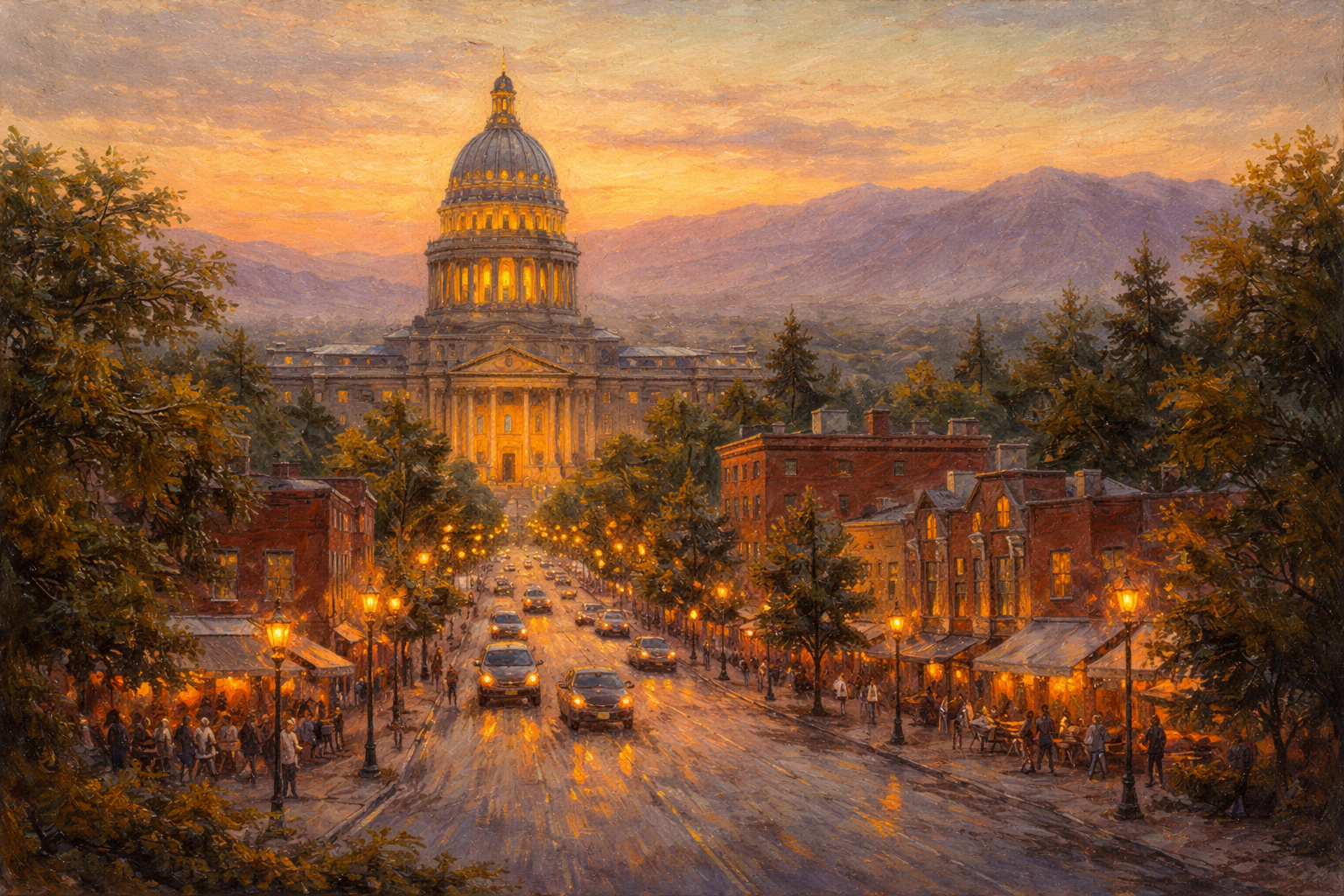
He also left behind a standard that is difficult to meet. Not every generation produces a public voice of that size. Most do not. Yet standards matter even when they are not met. They prevent historical memory from collapsing into trivia. Borah reminds Idaho that it once sent to Washington a man who was not content merely to be effective. He intended to be consequential. The difference is enormous.
And perhaps that is the right final measure. William E. Borah was consequential in the old sense: he altered the weather around him. He changed the emotional pressure of public debate. He made colleagues answer at a higher level than they might have chosen for themselves. He made Idaho larger in the nation’s imagination because he himself insisted on being large. Whether one fully admires the man or not, one cannot deny the achievement.
The Lion Still Roars
There are figures who vanish once the style of their era vanishes. Borah is not one of them. His beardless jaw, his chamber voice, his Senate combat, his lonely grandeur—these remain legible because they belong to something deeper than fashion. They belong to the republic’s old argument with itself over independence, obligation, power, speech, and the price of standing apart. Idaho has always been unusually alert to those themes. Borah did not invent them, but he gave them a face.
To call him the Lion of Idaho, then, is not mere nostalgia. It is a judgment about force. He brought to public life a scale of presence that still feels startling. He made Idaho sound like a state with claws and conscience. He made politics, for better and worse, feel worthy of a larger language. In an age when so much public speech is designed to evade memory, that alone is enough to keep him alive.