
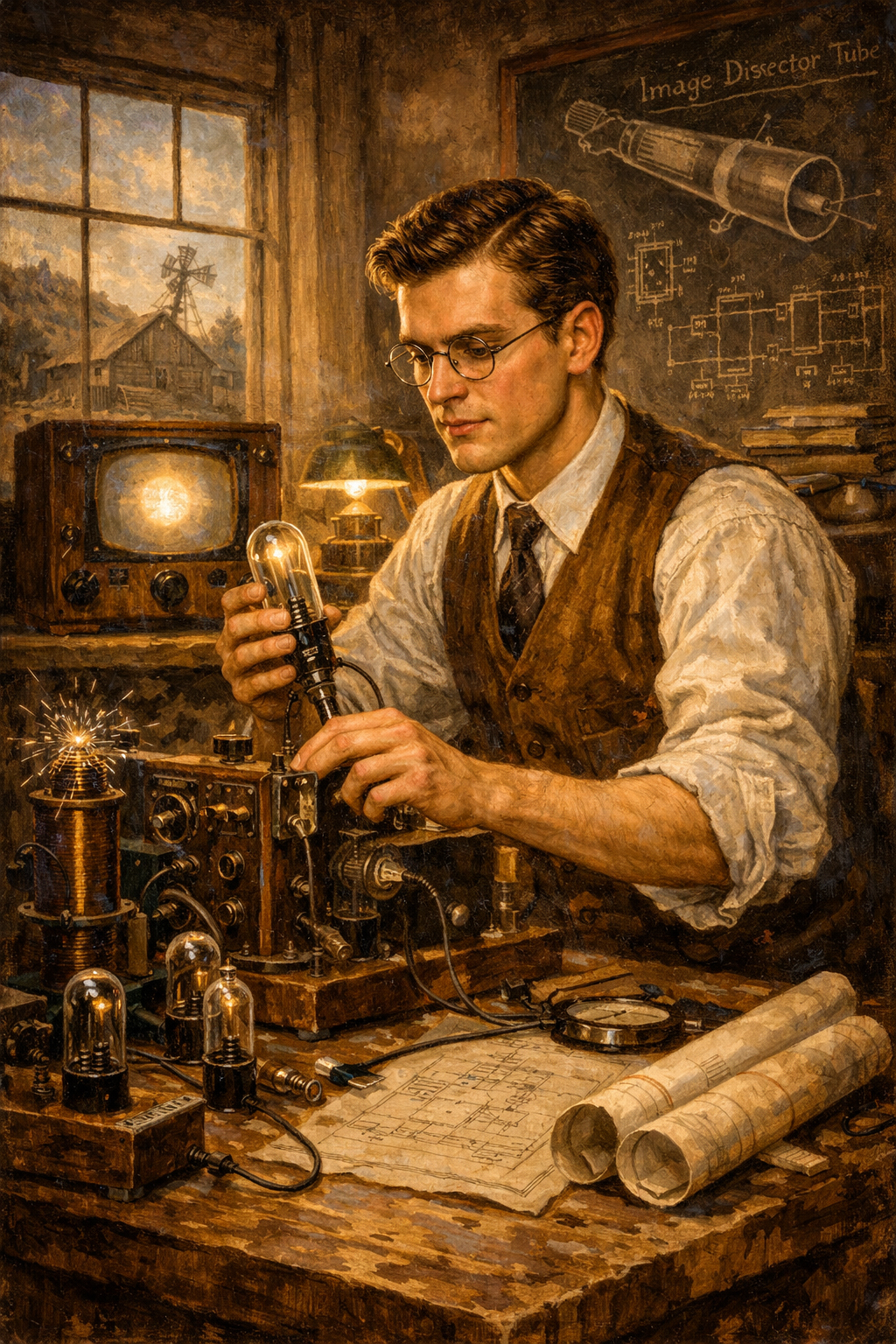
Inventor biographies are often written too neatly. They turn the young mind into a prophecy machine, scattering little foreshadowing scenes across childhood until genius appears inevitable. Real life is rarely that kind. And yet Farnsworth’s story tempts the biographer because one of its details is so almost offensively perfect: the boy on the Idaho farm, looking at the parallel lines of a plowed field, imagining a way images might be scanned electronically line by line. If one encountered the scene in a novel, one might call it overdetermined. In history, it remains irresistible.
Still, the real interest of Farnsworth lies not in anecdote alone, but in the type of intelligence the anecdote reveals. It is one thing to be mechanically gifted. It is another thing to see analogy where others see only labor. A plowed field is, for most people, a field. For Farnsworth it became a pattern, and then a principle. That leap—from the visible world into a transferable abstract system—is what separates cleverness from invention. Idaho did not simply provide scenery for his youth. It provided the material grammar through which his mind learned to think.
Philo Farnsworth saw in an Idaho field what much of the century had not yet imagined in a laboratory.
This is one reason he matters so much to the state’s self-understanding. Idaho is often narrated through toughness, distance, landscape, and competence. Farnsworth adds another and indispensable term: imagination. Not fantasy, not soft inspiration, but hard imagination—the kind that converts observation into system and then insists that the system can be made real. He belongs to the state’s tradition of practicality, yes, but at its highest and strangest register. He shows that practicality, in Idaho, can become visionary without ceasing to be grounded.
The Farm as Laboratory
There is a condescension sometimes attached to rural invention, as though the countryside can supply ingenuity only in quaint or improvised forms while true innovation belongs to metropolitan institutions. Farnsworth’s life is one of the better rebukes to that prejudice. The rural world did not limit the scale of his thinking. It trained it. On a farm one learns systems early: lines, cycles, timing, process, breakdown, repair. One learns that the world is made not only of appearances but of operations. This is not yet advanced electronics, of course, but it is a serious education in structure.
Idaho’s value in this story is therefore intellectual as much as biographical. The state offered not merely a childhood location, but a way of seeing things as arranged, workable, transformable. Farnsworth’s mind did not emerge from nowhere. It emerged from a setting where pattern and use remained close to each other. That matters. Invention often occurs where abstraction and reality still know each other’s names.
And perhaps that is why the Idaho dimension of Farnsworth feels so convincing. It is not a sentimental claim made after the fact. It is built into the logic of the story. One can believe that the same young person who noticed lines in soil might later think in lines of electronic transmission. The continuity is not magical. It is exact.
The Child Who Took Technology Seriously
Farnsworth also belongs to a class of American figures whom the culture both admires and misunderstands: the serious young technologist. We like the image of youthful brilliance, but we often flatten it into harmless charm. Farnsworth was not merely precocious. He was committed. He treated technical possibility with the solemnity other boys might have reserved for games, adventure, or social ambition. There is something almost severe in this. He did not simply enjoy machines. He believed problems ought to be solved.
That seriousness is an important part of his appeal. In a century increasingly shaped by technology, Farnsworth stands near the beginning of the moment when imagination and circuitry fully meet. But unlike the later myth of the inventor as showman-founder, he does not feel primarily theatrical. He feels absorbed. The image that endures is not of branding or charisma. It is of attention. A young mind noticing that existing methods are insufficient, and refusing to be satisfied by them.
Idaho has always had a place for this kind of person, even if it does not always advertise it well. The state prizes self-reliance, but self-reliance at its most interesting is not merely survival. It is constructive intelligence. It is the refusal to accept malfunction as destiny. Farnsworth is a great Idaho figure because he carries that ethic into the realm of world-changing technology.
The Device and the Century
To say that Farnsworth helped make television possible is to say something simultaneously precise and too small. Television was not just another machine. It became one of the great atmosphere-makers of the modern world, a device that reorganized politics, domestic life, entertainment, war, advertising, celebrity, memory, and attention itself. It changed not merely what people consumed, but how reality was publicly staged. For one Idaho-connected inventor to stand near the roots of that transformation is extraordinary.
And yet this is also where the story becomes bittersweet. Inventors are not always the final owners of the worlds they help create. The history of technology is full of men whose conceptual breakthroughs were larger than their practical rewards, men who built the future but did not always profit from it proportionately or control the institutions that followed. Farnsworth belongs partly to that lineage. The grandeur of the invention and the mess of the business are often neighbors.
He helped invent the machine that remade modern perception, yet his life still reads less like a corporate triumph than like an argument between vision and scale.
This too makes him interesting for Idaho. The state has long produced individuals whose competence exceeds the structures available around them. Farnsworth’s story resonates because it is not just a tale of success. It is a tale of magnitude meeting the usual world of competition, ownership, pressure, and imperfect reward. The genius remains unmistakable, but so does the cost of bringing genius into institutions not built to honor purity of invention.
Why He Belongs to Idaho’s Character
Some state figures flatter local vanity. Farnsworth does something better. He sharpens local standards. He tells Idaho that intelligence here need not be derivative, that the state’s contribution to modernity need not be limited to scenery, agriculture, politics, or frontier myth. He enlarges the possible self-image. Idaho can claim not only ruggedness, but original mind.
That claim should not be wasted. Regions often underestimate their role in the making of the modern world because they have accepted a prestige map drawn elsewhere. Farnsworth redraws the map slightly. He suggests that the future may begin in places not yet recognized as future-facing. This is one of the most hopeful things a state can learn about itself.
And there is something deeply Idahoan about the form his intelligence took. He did not emerge from glamour. He emerged from work, observation, pattern, and resolve. Even the famous plowed-field story carries that ethic. The insight comes not from escape from reality, but from a more penetrating encounter with it. A practical world becomes the occasion for radical thought. That feels right for Idaho. It remains one of the state’s best, if not always most advertised, qualities.
The Young Inventor as State Symbol
It may seem odd to call Farnsworth a symbol, since inventors usually belong more to patent history than to civic iconography. But symbols are not only statues and slogans. Sometimes they are habits of aspiration made visible in a person. Farnsworth symbolizes an Idaho that thinks rigorously and ambitiously without abandoning plainness. He is evidence that seriousness in a young mind can alter civilization.
That is a powerful thing for a place to remember. Not every child staring at lines in a field will invent a modern medium, obviously. But every culture benefits from honoring the kind of attention that could. Farnsworth’s story is an argument for education, curiosity, and the dignity of technical thought. It is an argument against the lazy division between human depth and scientific intelligence. In him, the two remain inseparable.

For The Idaho Identity, Farnsworth matters because he widens the state’s register. He adds invention to character, systems-thinking to scenery, technological imagination to the usual list of Idaho virtues. He is not an interruption in the state’s story. He is one of its highest expressions.
The Brightness That Remains
What remains of Philo Farnsworth is not just the claim that he helped invent television, though that alone would secure his place. What remains is the image of the young inventor: disciplined, observant, unwilling to accept the limits others took for granted. The image matters because it makes modernity feel personal again. Technologies often arrive to us as vast anonymous systems. Farnsworth reminds us that they begin in minds—specific minds, in specific places, under specific skies.
That specificity is part of Idaho’s gift in this story. It gives the invention human temperature. It returns the machine to weather, fields, youth, and thought. It says that the future was not produced only in the centers that later claimed it. Some part of it began where a young person in Idaho saw structure in the world and believed, with dangerous seriousness, that structure could be remade.
Philo Farnsworth is therefore more than Idaho’s young inventor. He is one of the state’s best arguments against underestimation. He proves that an Idaho beginning can be provincial only to those too lazy to recognize scale when it first appears in humble form.