
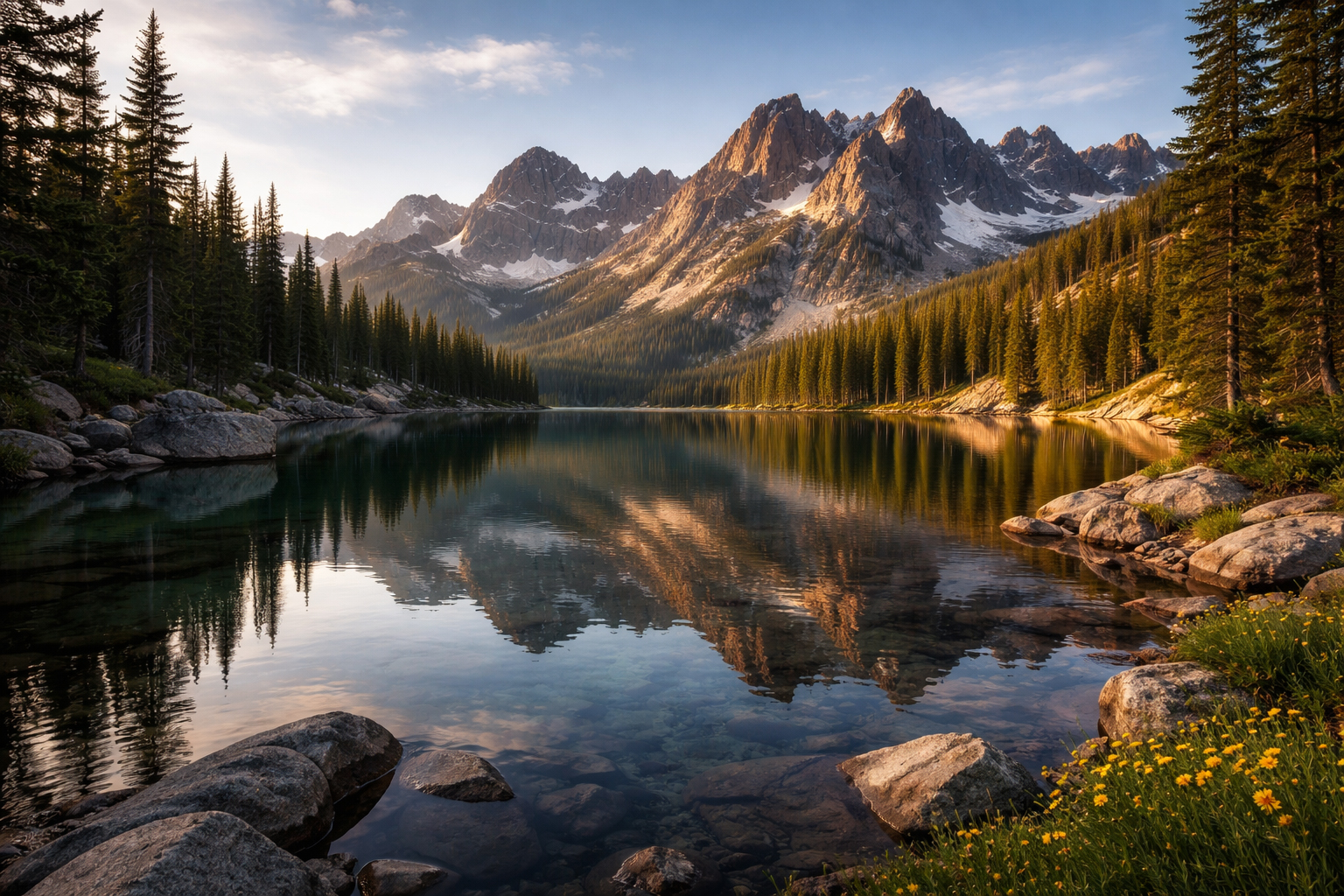
The phrase “alpine lake” can become too easy in western writing. It starts to sound generic, as though all high mountain water were interchangeable so long as the color is blue enough and the backdrop sufficiently dramatic. The Sawtooths deserve better than that. Their lakes differ in mood, access, scale, and social atmosphere, and a good page should let those differences stand. Redfish is not Stanley Lake. Stanley is not Pettit. Pettit is not one of the unnamed or trail-earned waters deeper in the wilderness. Together they form a grammar of silence rather than a single repeated image. :contentReference[oaicite:3]{index=3}
Silence is the right word, but not because the place is literally noiseless. Boat ramps, campgrounds, hikers, shuttles, and roads all exist here. Rather, the lakes give silence shape. They make the mountains stop behaving like spectacle alone and begin behaving like presence. Reflection does half the work. Shoreline does the rest. The eye becomes steadier. A person stands longer than planned. The whole region begins to feel less like a list of activities and more like a discipline of attention.
In the Sawtooths, the lakes do not soften the mountains into comfort. They translate them into stillness.
Real Places That Carry the Mood
The right anchors for this page should include one iconic lodge-and-lake pairing, one official orientation point, and two lake areas that let readers understand the differences in access and mood. These places do exactly that. :contentReference[oaicite:4]{index=4}
401 Redfish Lodge Rd, Stanley, ID 83278
Phone: (208) 774-3536
Website: redfishlake.com
Redfish is the most legible alpine-lake introduction for many visitors: historic lodge, marina, mountain backdrop, and a shoreline that immediately explains why the Sawtooth lake world deserves its own section. Official lodge contact pages confirm the address and phone. :contentReference[oaicite:5]{index=5}
442 Ranger Station Rd, Stanley, ID 83278
Phone: (208) 774-3000
Website: fs.usda.gov/.../stanley-ranger-station-sawtooth-national-recreation-area
The practical anchor for the page. Forest Service office pages confirm the address and phone. Even if many readers will not physically begin here, it is the correct official point of orientation for a serious Sawtooth lake story. :contentReference[oaicite:6]{index=6}
West of Stanley off Hwy 21, accessible from Stanley Lake Rd and Forest Service Rd 455
Website: fs.usda.gov/.../stanley-lake
The Forest Service describes Stanley Lake as west of Stanley off Highway 21, with lake access through Stanley Lake Road and Forest Service Road 455. It is one of the strongest “open alpine” answers in the region, broad and visually declarative, but still shaped by the same mountain quiet that defines the range. :contentReference[oaicite:7]{index=7}
Approximately 2 miles west of Hwy 75 on Forest Service Rd 208
Website: fs.usda.gov/.../pettit-lake-recreation-area
Pettit Lake is one of the clearest ways to show the southern side of the alpine-lake story. Forest Service pages place it roughly two miles west of Highway 75 on FS Road 208 and note its trailhead, water access, and base-of-the-peaks setting. :contentReference[oaicite:8]{index=8}
How the Lakes Differ
Redfish is the social icon. It can carry lodge history, summer traffic, marina life, sunset cruises, and still remain beautiful enough to justify every cliché people are tempted to use about it. Stanley Lake feels more spacious and slightly more austere, its view architecture almost too perfect to require editorial help. Pettit Lake gives the page a different, more tucked-away kind of alpine order, with trail logic nearby and a quieter southern entry into the Sawtooth mood. That variation is exactly what makes the page stronger. :contentReference[oaicite:9]{index=9}
The smart thing is not to pretend that one lake “wins.” The point is that each has a different relationship to silence. Redfish shows how beauty and social life can coexist. Stanley shows how scale can remain calm. Pettit shows how a lake can feel like a threshold into deeper country without losing accessibility altogether. The phrase “shape of silence” belongs to all three, but each shapes it differently. :contentReference[oaicite:10]{index=10}
The alpine lakes are not copies of one another. They are different methods by which the Sawtooths ask you to become quieter.
Why the Lakes Matter More Than the View
A mountain range can overpower the eye. That is part of its job. The lakes do something subtler. They give the eye a place to rest without reducing the mountains into background decoration. They turn vertical force into horizontal calm. They allow the visitor to receive the Sawtooths not only as peaks, but as atmosphere. This is one reason the area’s alpine lakes feel so essential to Idaho’s identity. They show that the state’s greatness is not only in scale, but in modulation.
That modulation is unusually precious now. Many scenic destinations have become so overtranslated into content and itinerary that silence no longer survives the experience intact. The Sawtooth lake world still holds some resistance to that. Even the more popular access points retain enough air, enough cold water, enough real mountain authority to keep the experience from becoming entirely domesticated. :contentReference[oaicite:11]{index=11}
The Shape of Silence
The title is doing real work here. Silence has shape in the Sawtooths because landscape keeps giving it one: shoreline curve, reflected ridgeline, open water, the pause before wind, the gap between voices on a dock, the trailhead moment before boots begin again. The lakes are where the mountains become legible in that quieter form. They teach stillness not as emptiness, but as structure.
That is why an alpine-lakes page belongs in a serious Idaho magazine. It is not merely a beauty page. It is a page about attention, about how the Sawtooths alter the mind when water is involved, and about the state’s rare ability to offer grandeur without insisting that grandeur be noisy. In the end, the lakes do not simply reflect the mountains. They refine them. That refinement is one of Idaho’s finest truths.