
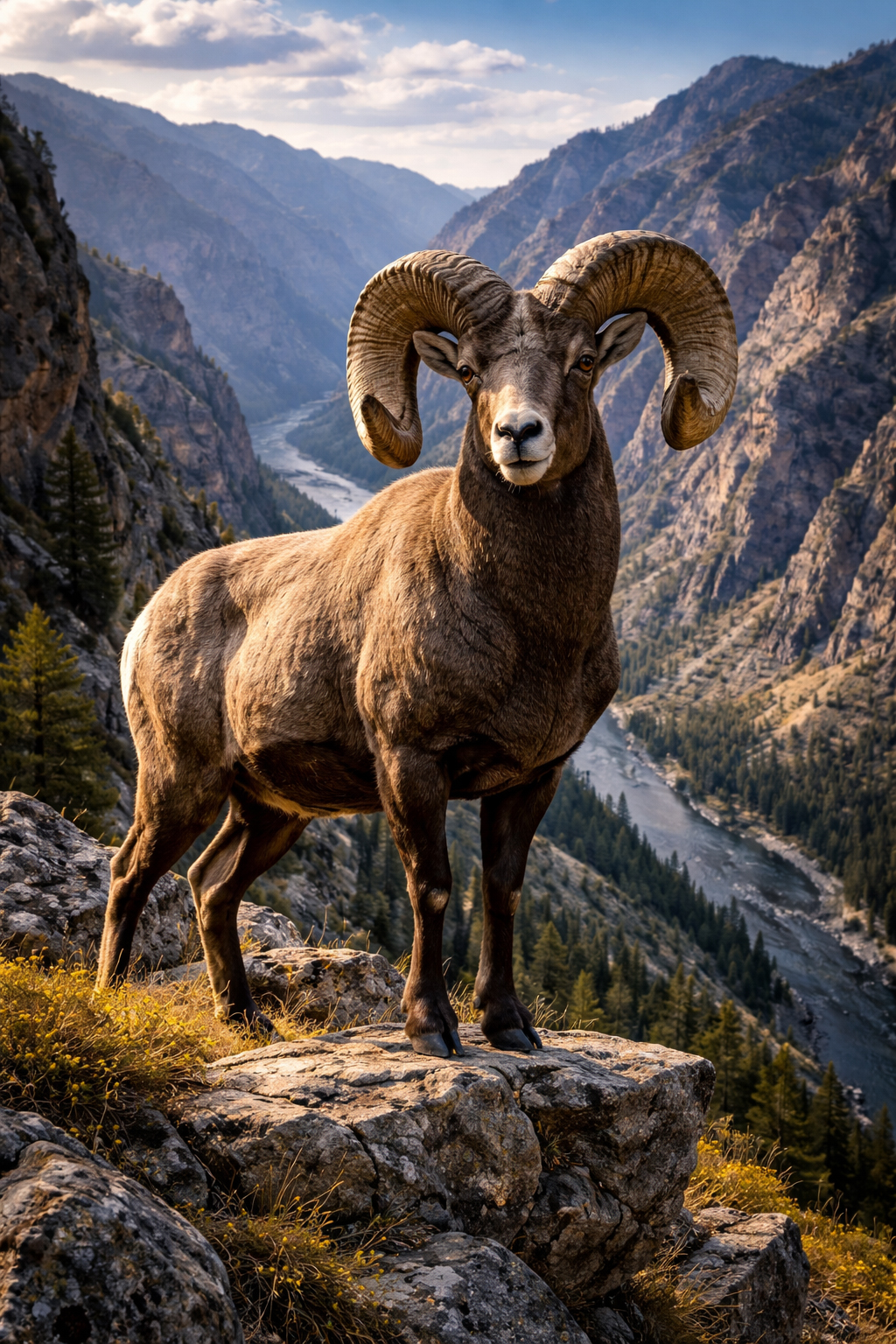
The first thing one notices about a bighorn sheep is not movement but confidence. The animal does not read as tentative, even when it occupies some impossible edge above an empty drop. It gives the impression of having solved gravity privately and long ago. That quality—quiet mastery in exposed country—is what makes it so deeply fitted to Idaho. This is a state where the most persuasive forms of beauty are rarely soft. They are controlled, exact, and answerable to the realities of rock, distance, and risk. The bighorn sheep belongs naturally to that register.
There are more glamorous western animals, if glamour is measured by mass appeal. Bears have bulk. Falcons have speed. Wolves have narrative. But the bighorn sheep possesses something rarer: a style of authority that comes from balance. It is one of the few creatures that can make a cliff look inhabited not by panic, but by judgment. In its presence the canyon stops feeling like scenery and becomes, once again, a working world.
The bighorn sheep does not make Idaho’s cliffs less severe. It makes severity look native.
This is one reason the animal lingers so strongly in western memory. The bighorn is not merely handsome. It is interpretive. It teaches you how to read the land. What had seemed a sheer wall becomes route. What had seemed a barren ledge becomes platform. What had seemed empty becomes occupied by a life whose terms are more exact than your own. In that sense the bighorn is not just a species on the canyon. It is the canyon’s own intelligence, briefly made visible.
The Meaning of the Ledge
A ledge is one of those landscape features that humans instinctively dramatize. It suggests danger, exposure, vertigo, the possibility of fall. This is reasonable. Our bodies were not designed to trust such spaces. The bighorn sheep transforms the meaning of the ledge by refusing to share our alarm. It does not merely survive at altitude. It composes itself there. That composure is central to its symbolism.
In Idaho, ledges matter because the state’s canyon country and broken ranges carry a certain moral atmosphere. They are not lazy landscapes. They ask things. They demand footing, judgment, patience, and respect for limits. The bighorn sheep answers those demands without flourish. One can hardly imagine a better emblem for a state that still admires capability more than chatter.
This is also why the animal feels older than the ordinary wildlife encounter. A trout may be beautiful, a moose impressive, a hawk quick, but the bighorn seems almost geological in its belonging. Its shape against canyon light feels pre-approved by the land itself. The animal is so suited to the place that it becomes difficult to imagine one without the other.
Horn, Weight, and Character
The curled horn gives the bighorn much of its mythic charge. It is one of nature’s great formal achievements: sculptural, heavy-looking, almost ceremonial in its profile. Yet the horn would mean less if it were attached to a clumsier animal. The genius of the bighorn lies in the combination. Weight joined to agility. Monument joined to movement. Force joined to exactness. It is a creature that carries ornament as if ornament were responsibility.
That phrase may sound excessive until one watches the animal in imagination against Idaho stone. Everything about it suggests concentration. Even rest looks active. Even stillness looks selected. This is not decorative wilderness. It is muscular attention. The bighorn sheep feels as though it has earned its silhouette through discipline.
There is something deeply Idahoan in that. The state’s best self-image is not decorative either. It values people and places that can carry weight without complaint, that can move through hard conditions without excessive self-display, that do not confuse drama with competence. The bighorn fits this ethic almost too perfectly.
A bighorn sheep on a canyon ledge is one of Idaho’s purest visual sentences: weight, danger, poise, command.
The Canyon as Social World
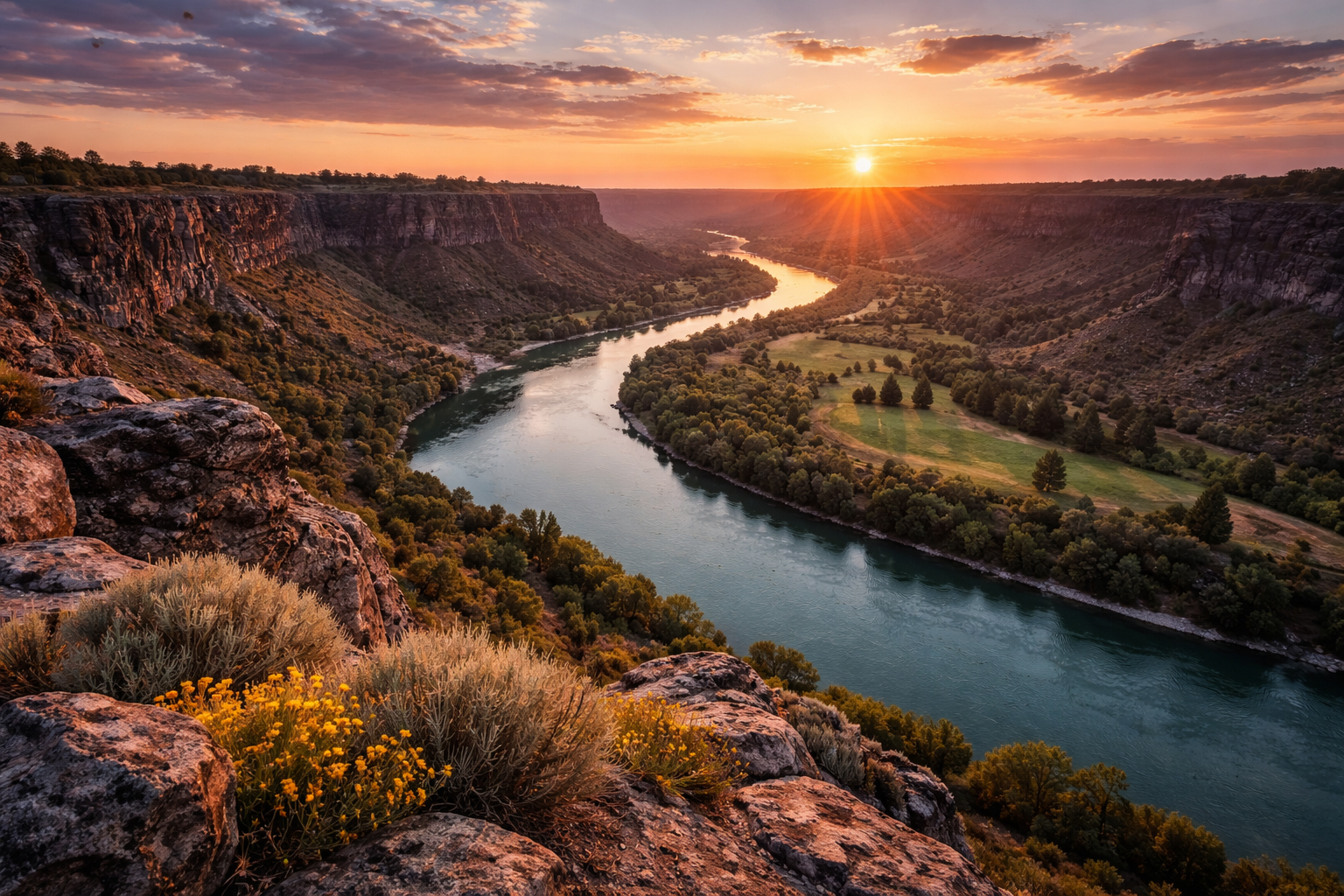
One of the mistakes human observers make with wild landscapes is to assume that if we find them inhospitable, they must therefore be empty. The bighorn sheep corrects that fantasy at once. The canyon is not empty. It is specialized. It belongs to animals whose bodies and instincts render what looks impossible into the ordinary. This matters because it returns dignity to the land. A place need not be immediately useful to us in order to be richly inhabited.
In Idaho, that correction is especially important. The state’s canyon country is too often consumed visually before it is understood ecologically or imaginatively. We admire the drop, the scale, the river line, the sunset, the photograph. The bighorn sheep interrupts that tourist rhythm. It asks us to consider the canyon as an actual life-world: route, refuge, high ground, habitat, and field of judgment. Suddenly the landscape becomes less a view and more a system.
This shift is one reason animals matter so much to the deeper identity of a state. They are not merely inhabitants. They are interpreters. They tell us what a place really is by showing us which traits it rewards. The bighorn sheep says, unmistakably, that Idaho rewards nerve married to balance.
Why the Bighorn Endures
Not every iconic western animal deserves its reputation equally. Some are overburdened by cliché. The bighorn sheep has been fortunate. It remains impressive even after a century of symbolic use because the actual creature is so persuasive. The image holds up. The horn. The stance. The ledge. The way the body seems at once dense and improbably capable. Nothing about it feels invented for our benefit.
And perhaps that is the secret. The bighorn sheep does not flatter us. It humbles us. It reveals how partial our own relation to the landscape remains. We look at a cliff and see obstacle. The sheep looks and sees path. We see risk where it sees instruction. This is one of the finest experiences wildlife can give us: the knowledge that the world contains intelligences formed by conditions we only dimly understand.
Above the Canyon
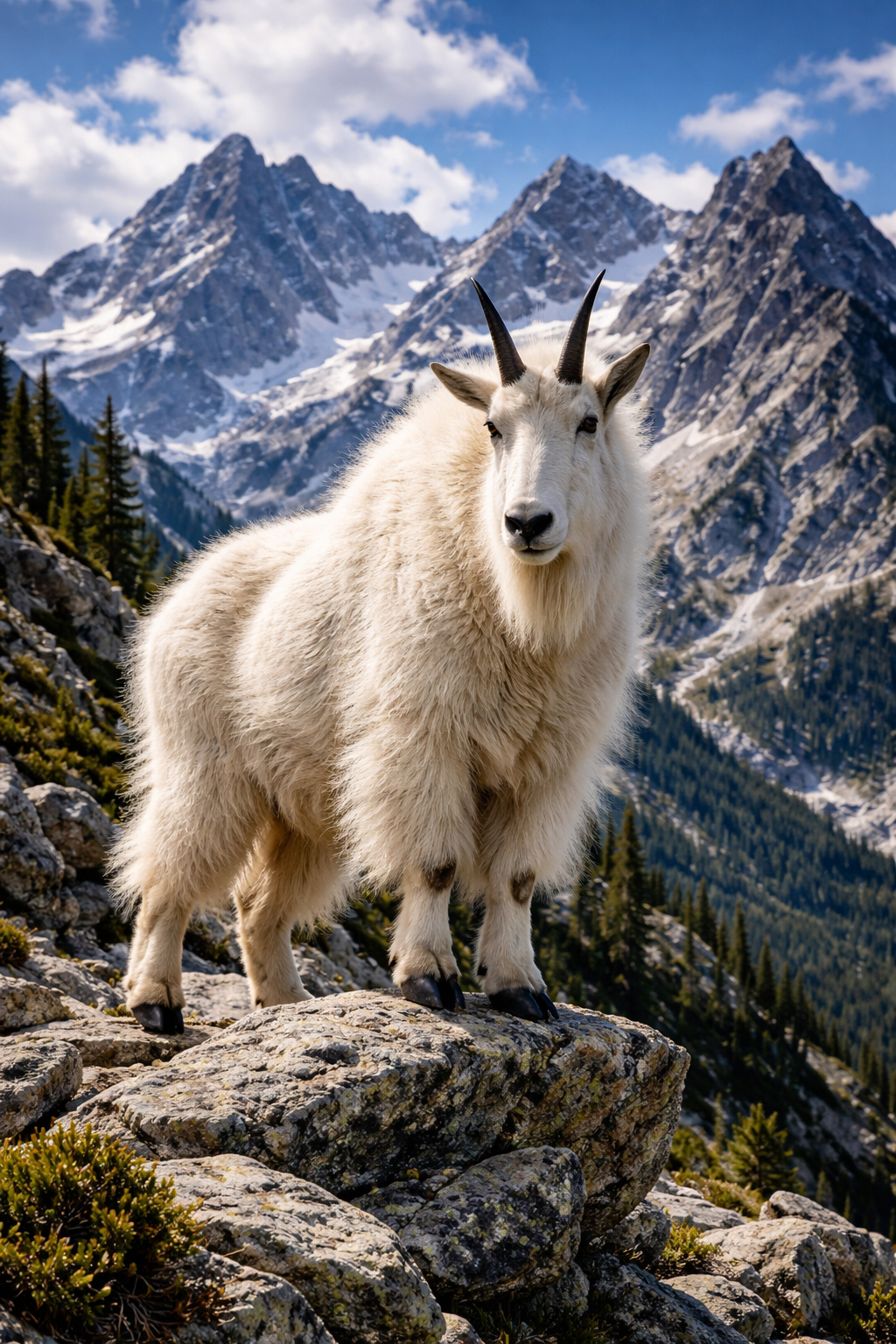
The title matters. Above the canyon. Not in it, not beside it, but above it. The bighorn sheep occupies precisely the position that changes the emotional logic of the scene. Height is part of its meaning. From above, it appears not simply as prey or survivor, but as watcher. A creature that has earned perspective through footing. A state like Idaho, with so much of its emotional power tied to altitude, needs such an animal. It gives height moral character.
This, finally, is why the bighorn sheep belongs in The Idaho Identity. It is not merely one more animal in the state’s natural inventory. It is a distilled statement about Idaho itself. The cliffs are real. The risk is real. The balance is real. The animal’s dignity comes from being equal to all three. So does much of the state’s own dignity.
Bighorn Sheep Above the Canyon: the phrase sounds almost mythic, but the real creature is better than myth. It is cleaner, harder, and more exact. It tells us that Idaho’s beauty is not merely scenic. It is structural. It belongs to places where poise is earned in exposure, and where the most memorable figures are those who can stand calmly on the edge without needing to advertise the fact.