
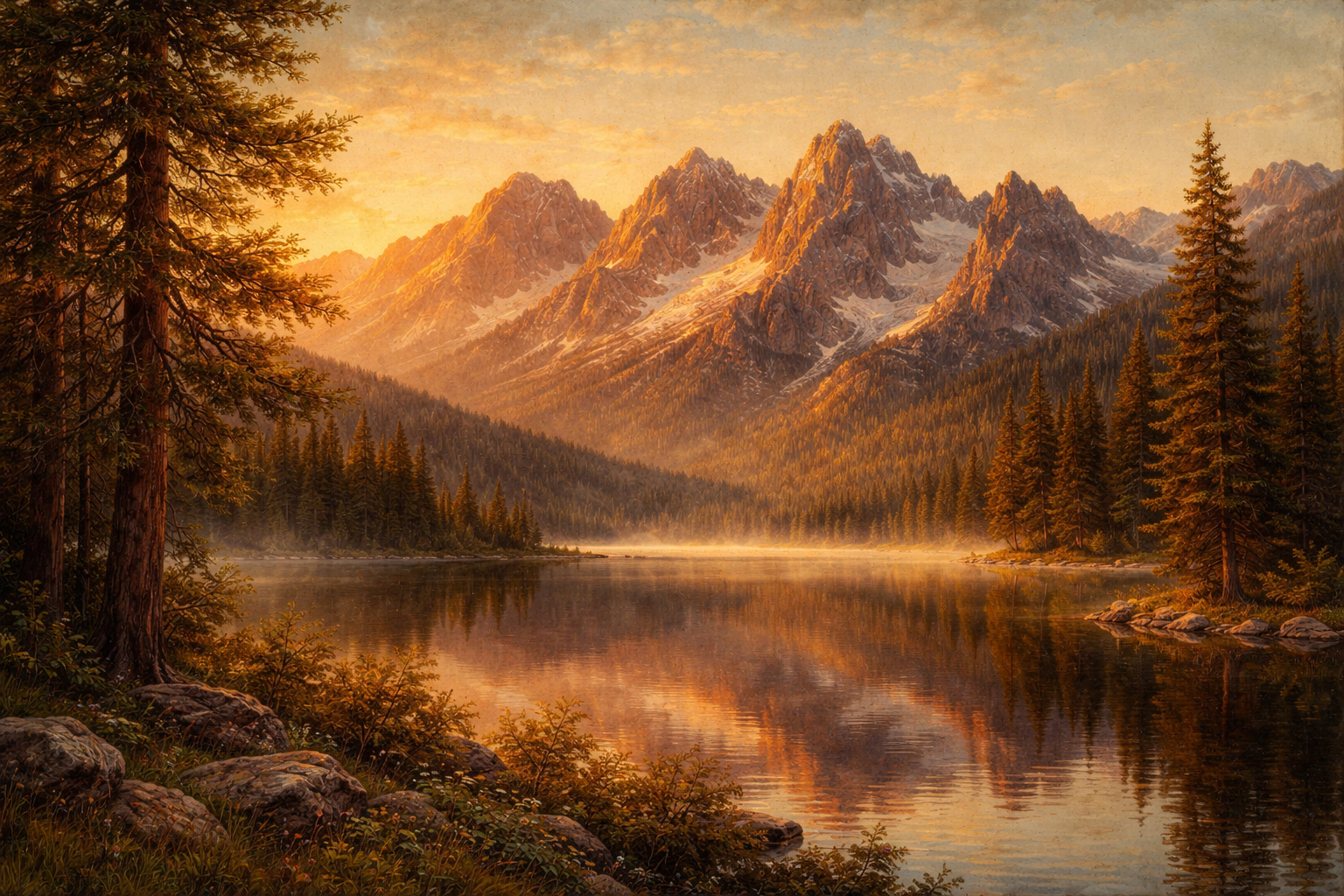
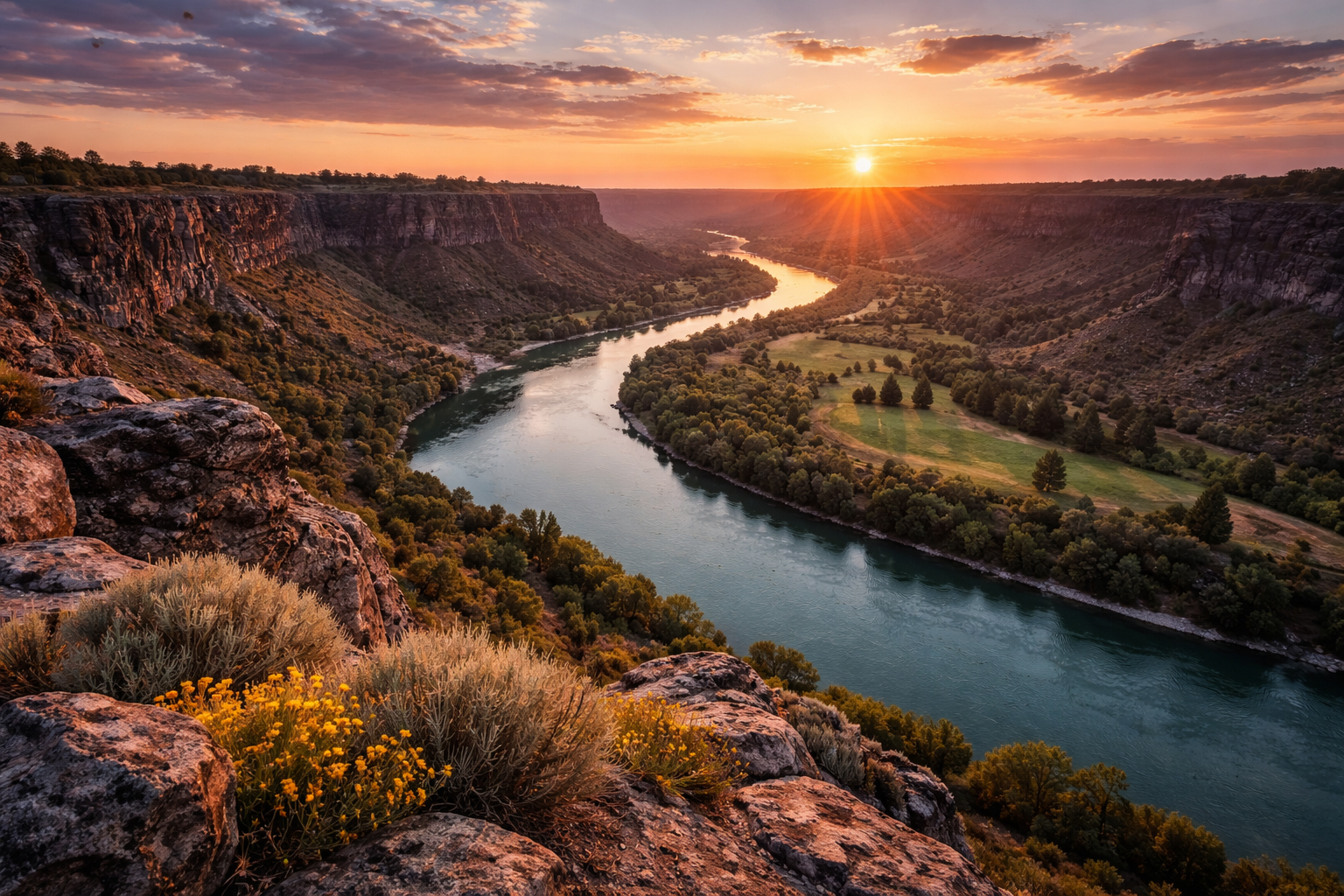
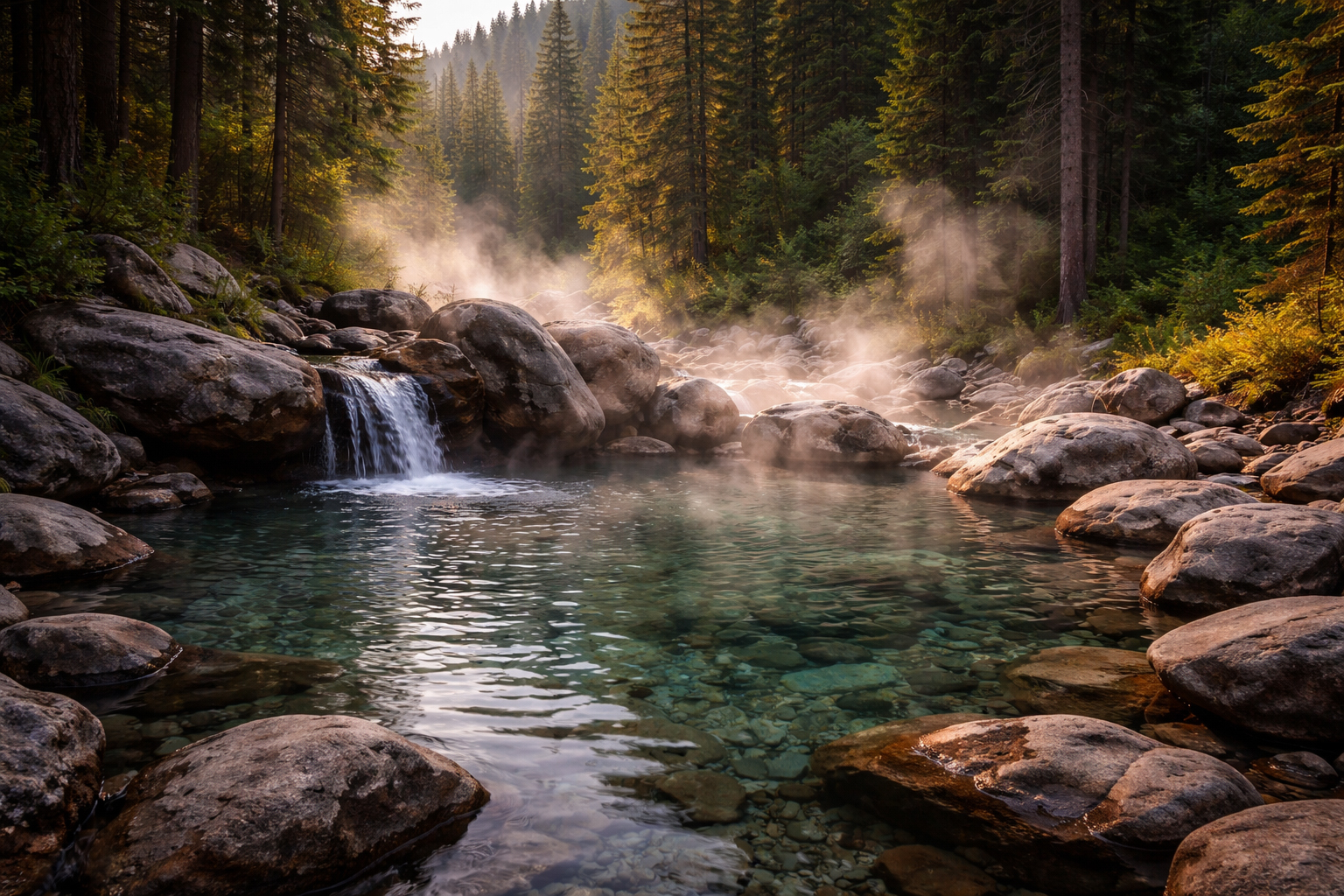
The first difference is scale, but not in the usual western sense. Many western states have scale. They have distance, sky, and dramatic landforms. Idaho’s scale feels different because it is paired with a strange kind of intimacy. One can move from Boise’s urban composure to Stanley’s twilight humility, from Coeur d’Alene’s lakefront polish to the Snake River Canyon’s geological theater, from hot springs in forest steam to food that tastes like cold water and working land. The state is large, but its large parts often feel personally legible once you enter them. Scale here does not simply dwarf. It arranges.
The second difference is silence. Not the marketed silence of luxury retreats, but actual silence with weather still inside it. Idaho has many places where quiet is not ornamental. It is structural. The Sawtooth lakes, the hot springs, the north woods, the winter valleys, the canyon rim before traffic intrudes—these places do not merely offer less noise. They alter the mind’s pacing. One begins to think in longer sentences. Or sometimes in none at all. This is harder to find than people admit, and Idaho still has enough of it that the state’s emotional weather is shaped by quiet as much as by spectacle.
Idaho feels different because it still contains places where the land, not the performance of the land, remains in charge.
The third difference is regional contrast. Many states contain varied landscapes; fewer contain varied landscapes that feel like different moral atmospheres. Boise is not merely a city in Idaho. It is Idaho’s argument for proportion. Coeur d’Alene is not merely a lake town. It is Idaho’s lesson in polish without losing the water’s authority. Stanley is not merely an access point. It is Idaho’s education in the dignity of stopping. The Sawtooths are not merely beautiful. They are disciplined. The Snake River Canyon is not merely dramatic. It is force made civic. Even the wildlife seems to distribute itself according to emotional register: the white sturgeon for deep time, the peregrine for precision, the wolverine for severity, the mountain goat for alpine composure, the caribou for northern mystery.
The State Does Not Flatten Easily
Part of what makes Idaho feel different is how poorly it behaves when treated lazily. It does not flatten well. Say “mountains,” and you have not said enough. Say “potatoes,” and you have said almost nothing. Say “outdoors,” and you have named a category too broad to be useful. Idaho’s identity lives in the finer distinctions that come after those first reductions fail.
This is one reason the state rewards magazine writing better than cliché. It wants sections. It wants mood pieces. It wants animal essays, food features, twilight stories, history pages, and place writing. Idaho is not difficult because it is obscure. It is difficult because it is over-simplified and under-read. Once one begins reading it properly, the state becomes surprisingly articulate.
That articulation is visible in the way Idaho holds opposites without strain. The state can be polished and rough, quiet and theatrical, lake-soft and canyon-hard, deeply local and unexpectedly cosmopolitan in small pockets. Sun Valley demonstrates one version of this. Ketchum sharpens it. Boise steadies it. Stanley purifies it. The state never quite settles into one mood for long, yet it still remains recognizably itself. That is a rare accomplishment in geography.
The Pressure of Standards
Another answer lies in standards. Idaho often feels as though the landscape is keeping standards higher than the culture around it sometimes expects. A mountain town cannot be entirely sloppy when the peaks above it are this exact. A hot spring cannot feel entirely trivial when the forest silence around it remains so complete. A lake cannot become merely decorative when its shoreline is still doing the work of reflection, weather, and cold depth. The state imposes a certain discipline on whatever is built beside it.
When that discipline is honored, Idaho becomes magnificent in a restrained way. When it is not, the failure is immediately visible. This may be one reason the state generates such strong feelings in people who pay attention. It makes mediocrity easy to detect. But it also makes excellence unusually satisfying when it appears. A good Boise evening, a proper Stanley stay, a well-written page about the Sawtooths, a dinner that respects Idaho ingredients, a publication with an identity equal to the subject—these things feel better here because the land has already set the terms.
Idaho feels different because it asks to be met at a higher level of attention than many places require.
The State of Earned Comfort
Comfort in Idaho has a distinct flavor. It rarely feels detached from effort. A winter soak matters because winter remains visible. A lodge cocktail matters because the mountains outside have already justified the firelight. A trout dinner matters because the state’s waters still feel present behind the plate. A twilight stay matters because the day’s altitude and distance have prepared the body to appreciate the room. Idaho is full of comfort, but it is often comfort earned against weather, road, cold, silence, or scale.
This helps explain why the state can feel unusually honest. The pleasures do not arrive floating free of the place that made them. They remain connected to source. That connection is one of Idaho’s deepest strengths. It creates a world in which food tastes regional, quiet feels geographical, and even luxury has to answer to mountain terms.
Such earned comfort is also part of the state’s emotional attractiveness. Idaho does not merely offer relief. It offers relief that still remembers what it is relieving you from. This is a more satisfying form of pleasure than frictionless ease. It keeps gratitude in the experience.
Why the People and the Places Feel Slightly Straighter
There is also a human dimension to Idaho’s difference, though it is best described carefully. The state often feels slightly straighter in its social posture. Not morally simplistic, not always agreeable, and not free from contradiction, but straighter in the sense of being less devoted to ornamental self-presentation. This shows up in many ways: in town scale, in architectural modesty, in the practical tone of many local places, in the relative lack of theatrical overdesign, and in the fact that many of Idaho’s most memorable experiences remain surprisingly direct.
That directness has aesthetic consequences. It keeps some places from becoming too mannered. It allows mountain towns to remain mountain towns. It lets a publication like this speak clearly without having to perform fake cosmopolitanism or folksy caricature. Idaho’s difference is partly that it makes sincerity look stronger than pose more often than many places do.
The State as Editorial Subject
Perhaps the deepest answer is that Idaho feels different because it can sustain interpretation. Some places offer one strong surface and then begin repeating themselves. Idaho keeps changing register. It can hold a wildlife section and a food section, a Boise section and a Stanley section, a history desk and a hot springs desk, and still feel like one authored state rather than a random collection of attractions. That coherence is not always obvious at first glance. It emerges through reading.
This is why Idaho invites an editorial project rather than just a travel site. The state’s identity is not singular enough for slogans and not chaotic enough to resist structure. It lives in the tension between those two states. The best writing about Idaho therefore becomes writing about relation: between mountains and lakes, city and river, canyon and bridge, lodge and cold air, wildlife and mood, history and present tense. Once those relations come into focus, the state becomes unmistakably itself.
Idaho feels different because it is not one scene. It is a system of scenes held together by tone.
The Final Answer
So why does Idaho feel different? Because it still has enough silence to shape thought. Because its regions do not blur into one another. Because comfort here remains tied to weather and effort. Because the land imposes standards. Because its best places refuse flattening. Because the state is more emotionally various than its clichés suggest. Because it can be written section by section and still resolve into one character.
And perhaps because Idaho does not always try to be understood too quickly. It allows first impressions, but it does not surrender to them. The state remains itself across second looks, third looks, longer stays, colder mornings, later dinners, quieter roads, and more attentive prose. That endurance is the surest sign of real identity. Many places can impress once. Idaho keeps becoming more exact the longer one remains in its company.
That is why it feels different. Not because it advertises the fact aggressively, but because the fact survives acquaintance. Idaho is not only distinctive in theory. It is distinctive in experience. The state keeps proving itself, one region, one silence, one river, one room, one animal, one dawn at a time.