
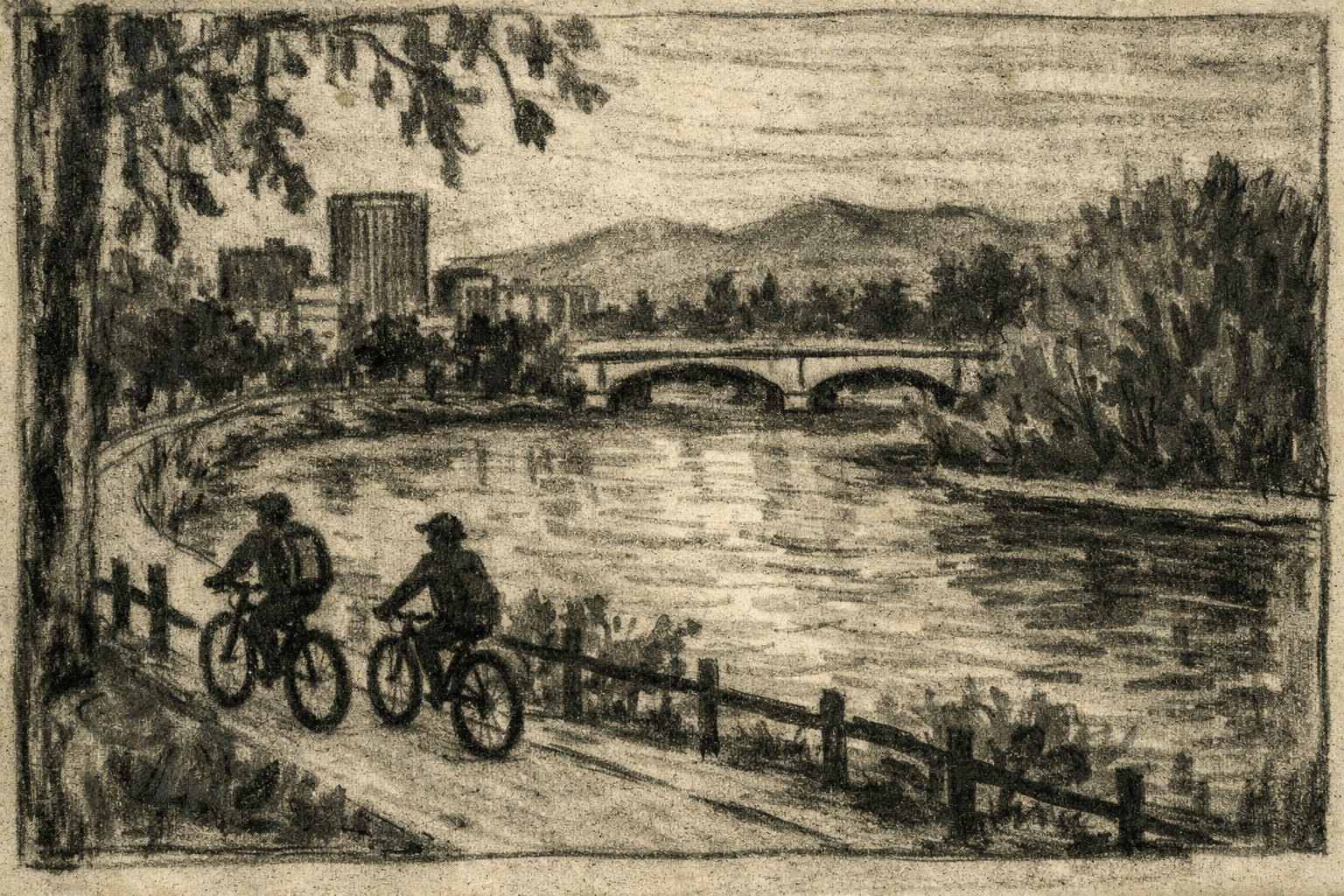
There are bike rides that exist for exertion and bike rides that exist for atmosphere. The Greenbelt does both, but atmosphere is its deeper gift. Cottonwoods and water carry the eye forward. Parks open and close like chapters. Bridges offer little moments of civic punctuation. The city appears in fragments rather than as a block of self-assertion. One sees Boise the way it is best seen: in intervals of calm.
This is why the ride suits Hiro, and why it suits this magazine. It is not performative. It is composed. You can ride hard here if you wish, but the Greenbelt seems to encourage a more intelligent pace. It asks you to notice. Wildlife. Light on the river. The difference between downtown Boise and Garden City. The way coffee tastes better after ten easy miles than after none. The way a city begins to feel more trustworthy once it gives pedestrians and cyclists something this generous.
The Greenbelt turns Boise into a city you can read at bicycle speed.
What makes the route especially satisfying is that it supports a day, not just a ride. You can begin with coffee, settle into the path, stop for an outdoor lunch or a riverside glass of wine, detour into the Idaho Botanical Garden if you want something quieter and greener still, and end with that particular post-ride appetite that makes simple things feel unusually deserved. The Greenbelt is not merely a corridor. It is an itinerary with dignity.
The Practical Shape of the Ride
A smart version of this page should acknowledge that the Greenbelt is not one single mood all the way through. Some stretches feel urban and social, others greener and more withdrawn. Some invite coffee and chatter; others suggest a quieter river rhythm. That variation is part of the pleasure. The path’s official identity is civic, but the lived experience is more literary: chapters of Boise unfolding beside water.
If you are building this as a real day page, the strongest approach is to recommend a flexible stretch rather than pretending one must ride all 29 miles to understand it. A very good Greenbelt day might include a downtown or Garden City start, a coffee stop, a mid-ride riverside pause, and one stronger destination such as Green Acres, Telaya Wine Co., or the Idaho Botanical Garden. That gives the page real usefulness without losing editorial style.
Real Places Along or Near the Ride
Below are strong, real anchors for the page.
1027 S Lusk St, Boise, ID 83706
Phone: (208) 429-6520
Website: boisebicycleproject.org
A strong practical inclusion for any Greenbelt story. Boise Bicycle Project is a community-focused nonprofit and bike shop, useful for tune-ups, repairs, or simply grounding the page in Boise’s real cycling culture.
214 E 34th St, Garden City, ID 83714
Phone: (208) 488-4747
Website: pushandpour.com
One of the best coffee anchors for a Greenbelt day. The Garden City location sits close to the river district and gives the ride a proper coffee intermission without breaking the mood.
767 S Pioneer St, Boise, ID 83702
Phone: (208) 856-6157
Website: greenacresboise.com
Green Acres describes itself as a seasonal outdoor venue along the Greenbelt, with rotating local food trucks, drinks, and live music. For a cycling page, this is almost too perfect: relaxed, outdoors, social, and directly tied to the path.
240 E 32nd St, Garden City, ID 83714
Phone: (208) 557-9463
Website: telayawine.com
Telaya’s tasting room sits right on the Boise Greenbelt and next to the Boise River. It is one of the best places on the route to end a late-afternoon ride with a slower, more polished Idaho note.
2355 Old Penitentiary Rd, Boise, ID 83712
Phone: (208) 343-8649
Website: idahobotanicalgarden.org
Not directly on the river path in the same way as the others, but a worthwhile detour if you want the page to feel fuller and more day-long. It adds another Boise virtue to the ride: cultivated quiet.
How to Ride It Well
The Greenbelt is best approached with a little courtesy. The city’s official etiquette notes that pedestrians have the right-of-way, the path is open from sunrise to sunset, and users should stay on designated trails. That practical civility is part of the route’s beauty. It feels like shared urban life working properly, which is rarer than it should be.
That is also why the Greenbelt should not be written like a conquest. The point is not mileage bragging. The point is the Boise sequence: roll out, settle in, watch the river, stop for coffee, drift toward Garden City, eat something outdoors, maybe continue farther, maybe not. It is a ride that improves when you leave a little room around it.
The best Greenbelt day is not the one with the most stops. It is the one that leaves you feeling that Boise has been properly paced.
The Boise You Meet on the Path
There is a version of Boise that reveals itself only when one is not driving through it. On the Greenbelt, the city feels less eager and more secure. You pass under trees rather than under headlines about growth. You see families, runners, cyclists, dogs, river birds, patios, parks, and neighborhoods in a sequence that feels earned rather than staged. Even Garden City, which can seem industrial or transitional from the wrong angle, becomes part of a coherent riverside culture when approached by bike.
This is what the page should finally say. Cycling the Greenbelt is not only an activity. It is a method of understanding Boise. The ride explains why the city feels more composed than many of its peers. It explains why the river matters. It explains why good coffee, an outdoor food stop, a tasting room, and a bike path can together amount to civic style.
Cycling the Greenbelt, then, is one of the best Boise features you can build because it is both useful and true. It gives readers an actual day, actual places, and the right conclusion: that one of Idaho’s most attractive urban experiences is also one of its calmest.