
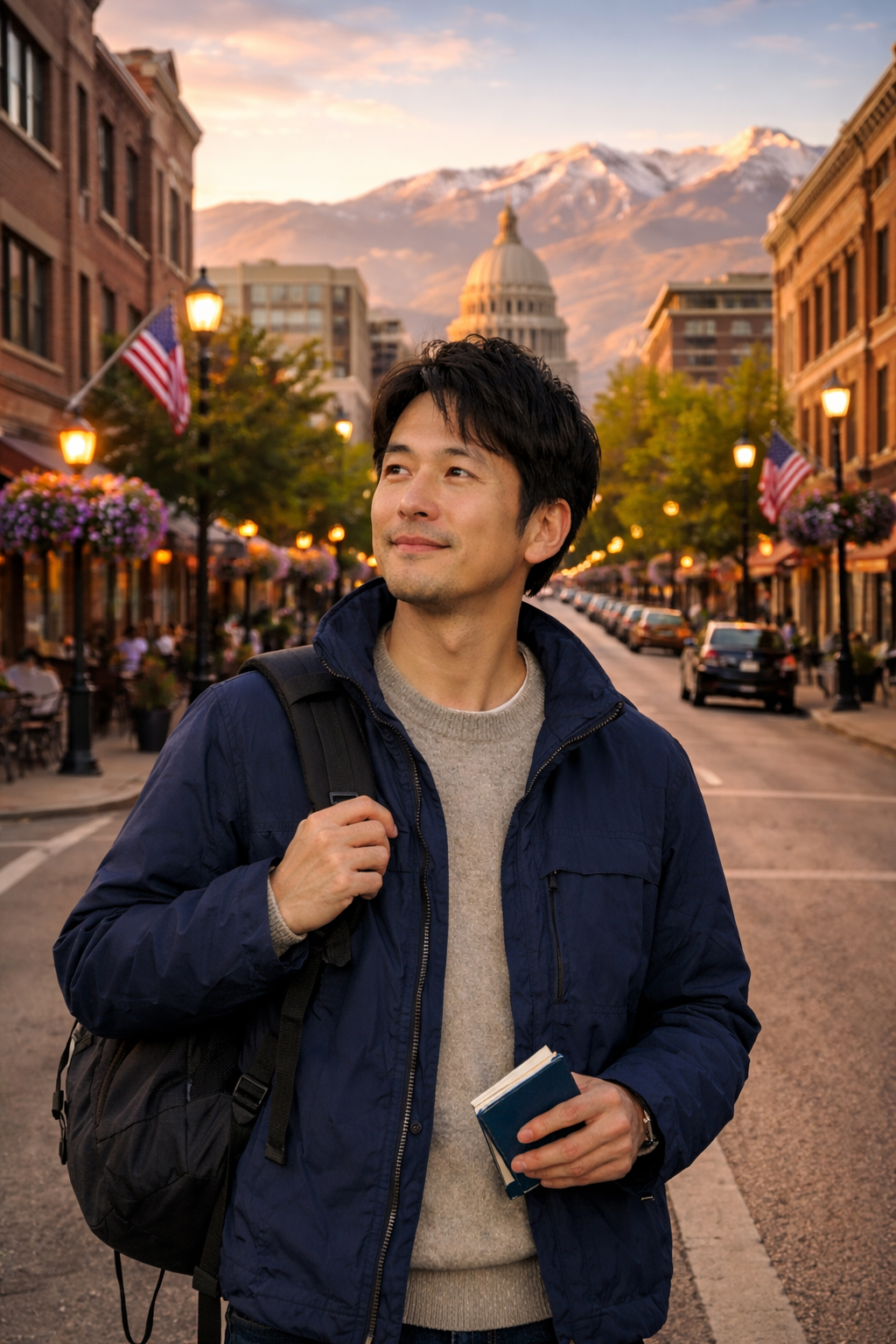
He comes in at the hour when stone begins to warm from the side rather than from above. The light has thinned into something more flattering and more exacting. The day is not finished, but it has relinquished its coarser energy. Hiro notices this before he notices anything else. He notices the air, the spacing, the proportion of street to building to sky. He notices that the city seems to know what it is. Or perhaps more precisely: it does not seem anxious about what it is.
Boise is a useful first lesson in Idaho because it overturns the easiest assumptions. A visitor arriving from outside might expect either frontier roughness polished into a lifestyle product or a smaller western capital eager to prove its sophistication in oversized gestures. Boise chooses neither route. It does not mimic somewhere else’s metropolitan confidence, nor does it overplay regional charm. Its poise comes from restraint. Hiro, who has learned that restraint is often the highest form of intelligence, reads that quickly.
Boise does not seduce by exaggeration. It persuades by composure.
He has been to enough American cities to know their common forms of insecurity. Some compensate through volume. Some through self-conscious design. Some through relentless claims to hidden coolness, as though the city were desperate not to be left out of the conversation. Boise appears refreshingly uninterested in this drama. It does not beg for classification. It lets the evening settle. It lets a building be dignified. It lets a block breathe. It leaves a little room around itself, and that room is one of the first things Hiro admires.
There is also the matter of speed. A city reveals its confidence by the pace at which it demands reaction. Boise does not insist that one be instantly dazzled. The reaction time is slower, and that slowness becomes a pleasure in itself. Hiro does not feel pressed into enthusiasm. He feels allowed to notice. The distinction is small in wording and enormous in experience. Too many destinations confuse the visitor’s stimulation with the visitor’s respect. Boise aims for something better. It seems to believe respect can arrive quietly.
The First Clue
The Idaho State Capitol appears not as spectacle but as evidence. It is there in the evening light, calm in its authority, not overburdened by theatrical setting. Hiro takes it in almost the way one reads a person’s posture before hearing them speak. It tells him something about the civic temperament around it. This is a place that values order without stiffness, ceremony without excessive self-importance, visibility without vulgarity. The building is not trying to rescue the city’s identity by itself. It belongs to a larger tone.
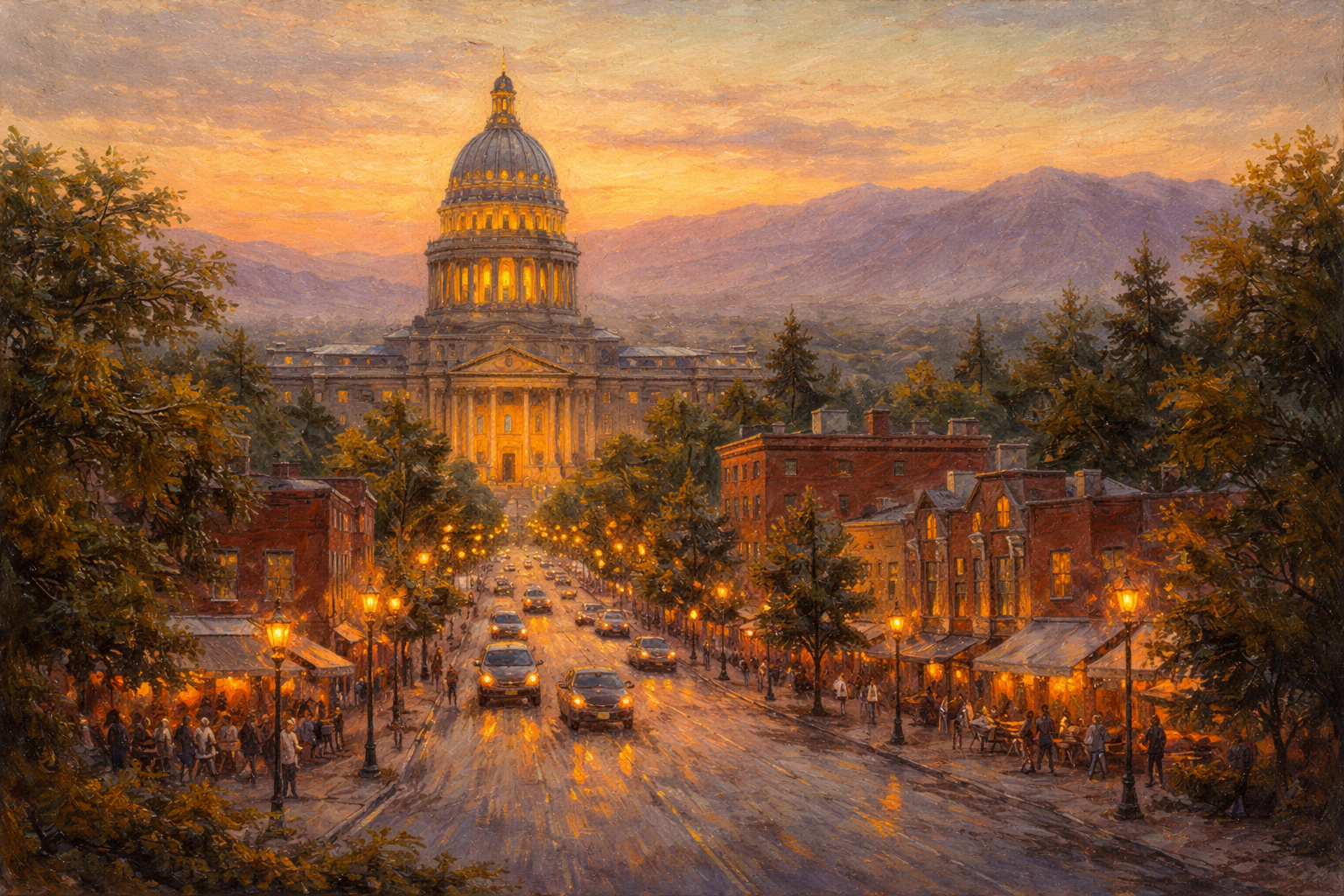
Hiro is sensitive to these tonal matters. He notices when a city’s buildings seem at war with its self-image. He notices when public space feels defensive, overcompensating, eager to perform importance. Boise feels settled in a more appealing way. Even on first arrival, it gives the impression of a city that has accepted its own scale and learned how to work beautifully within it. That kind of acceptance is difficult. It usually arrives only after a place has outgrown the adolescent need to imitate larger rivals.
He walks, and walking is part of the education. Some cities announce themselves best from behind glass. Boise improves at human speed. Hiro notices tree lines, shopfronts, the behavior of light on stone and pavement, the ease with which the city shifts from civic center to lived-in neighborhood feeling. There is no need to invent romance where none exists. The charm is real, but it is adult charm: confident, unhurried, a little dry, unwilling to flatter cheaply. It suits him.
Why Boise Makes Sense to Hiro
What Hiro likes in a place is not always what the tourism industry knows how to describe. He values rooms that do not announce themselves too loudly, service that remains competent without becoming overfamiliar, city streets that preserve a little formality, and destinations whose beauty still seems answerable to weather rather than to mood boards. Boise, even before he has any theory about it, offers the beginnings of all this. It suggests a state where usefulness and cultivation have not been forced apart.
That matters because Hiro distrusts aesthetic environments that float free of reality. He dislikes places that seem designed only to be photographed, places where comfort is severed from the conditions that make comfort meaningful. Boise does not have that severed quality. It still feels connected to a wider Idaho logic of season, distance, and practicality. The city’s refinement is persuasive precisely because it does not appear to have erased the state around it. One feels that beyond these streets lie weather, rivers, roads, snow, heat, labor, and open country. Boise is civilized, but it is not insulated from truth.
Hiro does not love Boise because it pretends to be larger than it is. He loves it because it refuses to be smaller than itself.
That sentence captures much of his early response. Boise does not engage in the false modesty that often weakens smaller cities. It does not apologize for not being somewhere else. Yet neither does it inflate its credentials. It has the more difficult virtue of proportion. Hiro responds to proportion instinctively. He trusts places that do not overspeak. He trusts cities that understand the value of reserve. Boise, in the first evening, proves itself one of those cities.
Arrival as Correction
Travel, at its best, corrects expectation. Not by humiliating it, but by refining it. Hiro’s expectation of Idaho had not been exactly foolish; it had merely been incomplete. He expected mountain grandeur, a certain western spaciousness, perhaps a touch of frontier severity softened by contemporary polish. All of that might still prove true. But Boise introduces another element he had not sufficiently anticipated: composure. Idaho, at least in this first urban encounter, is composed.
That composure becomes a kind of key for everything that follows. The state’s later pleasures—alpine lakes, steam rising from hot springs, a lodge glowing against twilight, trout on a plate, cold air sharpened by pine, the enormous but orderly calm of the Sawtooths—will all make more sense because Boise taught him the register early. Idaho is not trying to overwhelm him. It is trying to align him. It is teaching him, even here, how to receive it.
This is a deeper form of arrival than the usual one. Many travelers think arrival means the instant when a place begins to entertain them. Hiro knows better. Arrival is when the place begins to revise your senses. Boise does that gently. It slows his internal tempo. It makes him more attentive to spacing and tone. It lowers the volume of expectation. By the time he reaches dinner, he is not searching for what the city is supposed to impress him with. He is simply there, which is a harder and more valuable condition.
An Evening City
Some cities are morning cities. They look best when the day is still idealistic, before commerce becomes fully visible. Others are night cities, dependent on darkness, velocity, and lighting strategy to complete their effect. Boise, for Hiro, becomes an evening city. Evening flatters it because evening reveals its character rather than disguising it. The daylight order remains visible. The night’s intimacy begins to gather. The civic and the personal overlap for an hour or two in a way that feels unusually balanced.
He notices people moving without frenzy. He notices that restaurants and bars seem to grow out of the city rather than to stand apart from it in search of attention. He notices that Boise’s social life has edges and boundaries, which is to say it has manners. This again appeals to him. A city without manners exhausts the visitor quickly. Boise’s manners are among its most attractive forms of intelligence. They suggest that life here does not depend on continuous performance.

Dinner confirms the mood rather than changing it. The food is good, but what interests him more is the way appetite itself seems less theatrical here. A meal in Idaho can still feel connected to climate, season, and labor. It does not need to become a stage production to justify itself. Hiro appreciates this more than he says. He has eaten too many expensive meals in places that never learned the difference between fuss and care. Boise, like Idaho more broadly, seems better at care.
What Begins Here
It would be excessive to claim that Hiro understood Idaho fully on this first Boise evening. He did not. But understanding does not arrive all at once. It begins where tone becomes legible. Boise made the tone legible. It introduced him to a state that prefers confidence to clamor, structure to sprawl, room to congestion, and clarity to overstatement. Those are not small preferences. They amount to a philosophy.
By the time he returns to his hotel, Idaho has already lodged itself in him—not yet through the grand images for which the state is justly admired, but through something more useful. Through civic calm. Through light on stone. Through the refusal to oversell. Through the pleasure of a place that seems content to let him come closer on honest terms. That is the beginning of almost every worthwhile travel relationship. Boise, on first arrival, understands this. Hiro does too.
Later he will stand before mountains, lakes, hot springs, canyon overlooks, and winter light. Later he will realize how deeply Idaho’s landscapes can reorder thought. But the first memory remains Boise at dusk: a city neither defensive nor boastful, one that introduced the state by revealing its manners. In retrospect, it was the ideal arrival. Idaho did not seize him. It met him. And because it did, he was ready to keep going.