

He had seen American landscapes before, of course. He had seen the well-known arrangements: the desert made theatrical, the coast made cinematic, the city made proud of its own reflection. Idaho was different from the first minute because it did not appear eager to perform itself. The light over Boise carried a certain steadiness. The buildings did not strain after grandeur. The streets seemed civilized without being self-conscious. Even the air felt measured. It suggested a state less interested in first seduction than in long acquaintance.
What Hiro first saw, then, was not just scenery. He saw proportion. That is not the kind of observation many tourists are trained to make. They arrive expecting the iconic and the instantly narratable. Idaho offered something more elusive and, in the long run, more rewarding: the sense that things were properly scaled. The city was not pretending to be larger than it was. The evening was not trying to become an event. The beauty was not decorative. It simply existed, quietly coherent.
Idaho’s first gift to Hiro was not shock. It was accuracy.
That word may sound strange in a travel essay, but it is the right one. Some places encourage exaggeration. They enlarge the visitor’s mood until it becomes difficult to tell whether one is responding to reality or to branding. Idaho did not produce that confusion. It sharpened things instead. Hiro felt almost immediately that his senses had become less cluttered. The horizon looked cleaner. The evening seemed less interrupted by noise, social or visual. He was not being invited into fantasy. He was being invited into attention.
And attention, for a traveler like Hiro, is nearly everything. He does not believe that understanding begins with conquest. He believes it begins with the willingness to remain still long enough for a place to establish its own terms. Idaho was unusually good at this. It did not crowd him with meaning before he had earned any. It offered atmosphere, sequence, distance, and room. From the first sight, he felt the state’s confidence in its own pace.
The Boise Lesson
It is fitting that Hiro first saw Idaho through Boise rather than through some grand isolated wilderness scene. Boise introduces the state well because it contains one of Idaho’s governing paradoxes: refinement without pretense. A person arriving there does not receive the western stereotype in its loudest form. He receives something much more informative. Boise offers order, civility, and a kind of urban modesty that turns out not to be modesty at all, but discipline.
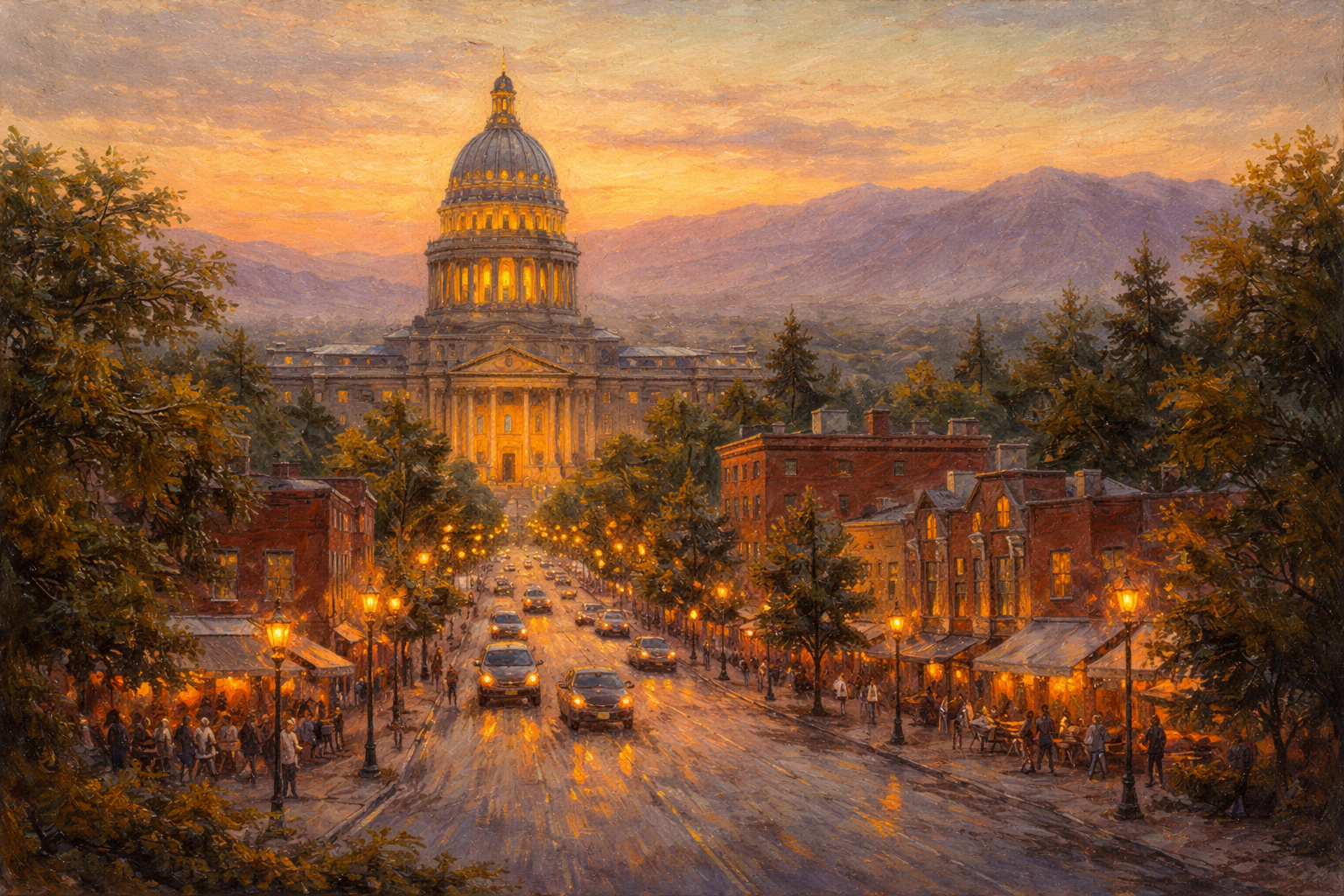
Hiro noticed the capitol light. He noticed the way a downtown street could feel inhabited rather than overactivated. He noticed that Idaho’s idea of attractiveness did not seem to depend on endless stimulation. There was nothing dull about this. On the contrary, it required a more mature eye. A lesser place shouts its personality because it fears you will miss it. Boise assumed that if you were worth the trouble, you would notice on your own.
This was Hiro’s first real clue. Idaho might be a state built not around self-display, but around self-possession. The distinction matters enormously. Self-display is exhausting. It is forever asking to be admired. Self-possession has no such need. It knows its own scale. It allows room around itself. It can be stylish without becoming needy. Boise, in that first evening register, taught Hiro that Idaho had this quality, and once he sensed it, he began to see it elsewhere.
The First Misreading
Every first sight includes an error. The error is part of the education. Hiro’s initial misreading was to think that Idaho might be simple because it was clear. This is a common mistake. Clarity of atmosphere is not the same thing as simplicity of character. Idaho’s landscapes often appear legible at first glance: mountain, river, lodge, pines, sky, snowline, field. One thinks one understands. Then the state proceeds to complicate that easy reading through mood, restraint, weather, tone, and the peculiar dignity of its spaces.
Hiro began to feel this almost at once. The openness was not emptiness. The quiet was not a lack of life. The modest social tone was not provincial uncertainty. Everything he first took as straightforward turned out to contain another layer. Idaho was not trying to hide itself. It simply assumed the observer would do some work. For Hiro, this was enormously appealing. He distrusts places that make themselves fully available in the first five minutes. Such places usually have little left to say after that.
Idaho was more sophisticated than its first simplicity suggested. This sophistication did not look coastal, metropolitan, or performatively contemporary. It looked like confidence without overstatement. It looked like warm light on stone. It looked like a good room in cold weather. It looked like a meal that did not need twelve adjectives to justify itself. It looked like scale that did not ask permission to matter. Hiro first saw all this in fragments, before he had language for it, but that does not mean he missed it. Sometimes one recognizes a place emotionally before one can phrase it correctly.
Distance as a Form of Courtesy
One of the first things he loved, though he might not have called it love yet, was the distance. Not only geographical distance, though Idaho has plenty of that, but social and aesthetic distance too. There was room around buildings. Room around roads. Room around interactions. Room around the evening itself. A lesser traveler might find this underwhelming. Hiro found it elegant.
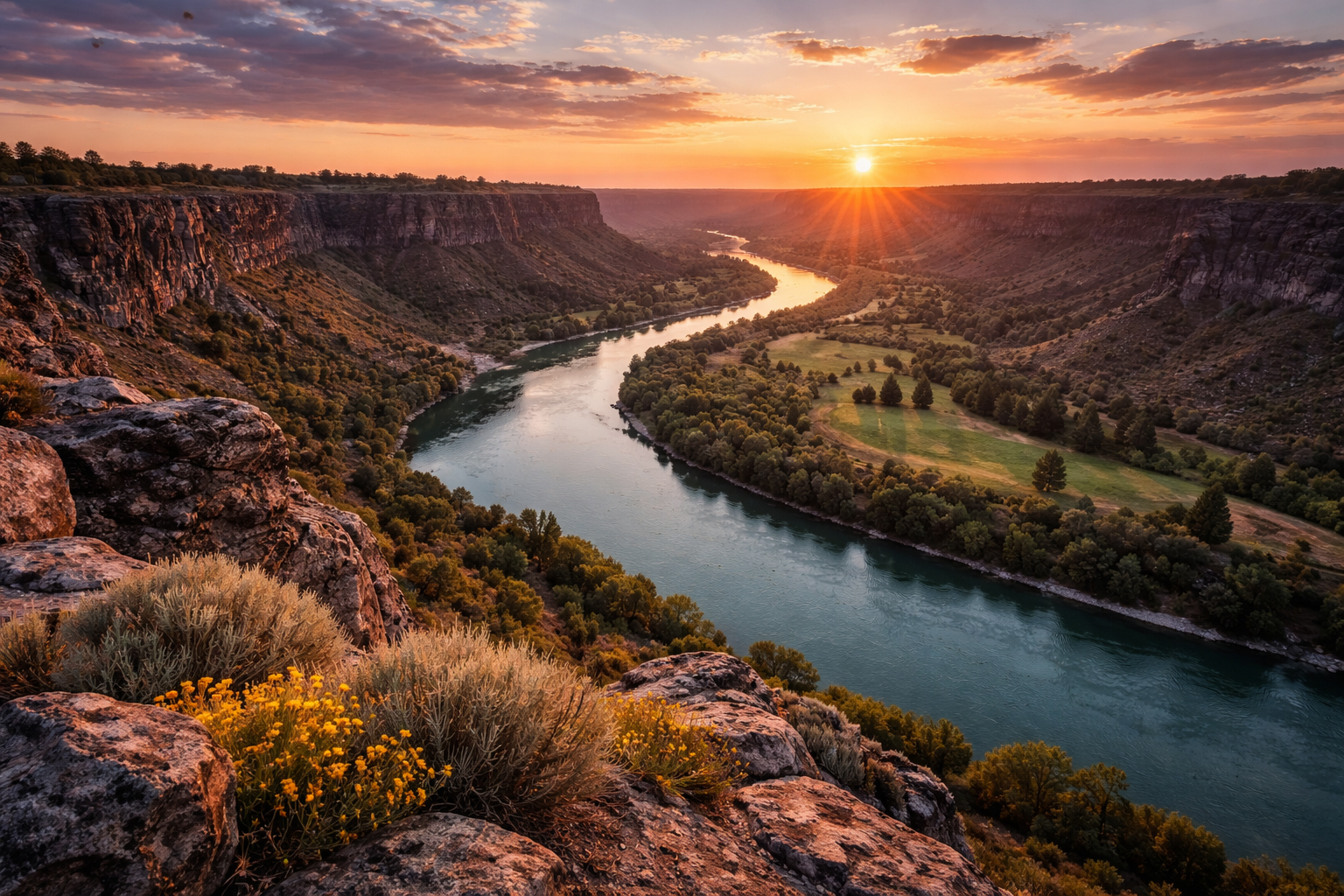
He has long believed that distance can be a form of courtesy. Good design understands this. Good conversation does too. Not everything should be pressed too close. Not every view needs interpretation shoved into it. Idaho seemed to share this philosophy. It allowed mountains to stand at their own remove. It allowed the traveler to arrive gradually. It allowed the state’s own beauty to remain partly undomesticated. The result was not alienation. It was respect.
Hiro first sees Idaho, then, as a place that does not clutch. That is a large part of why it eventually stays with him. The state makes a subtler first impression than louder destinations, but subtler impressions are often the ones that age best. They continue to unfold in memory because they were never exhausted on contact.
What the Eye Learns Before the Mind
The eye often learns faster than the intellect. Hiro’s eye had already noticed several things by the time his mind began organizing them: a preference for clean lines over clutter, a hospitality of space rather than excess, a seriousness in the way evening behaved, and a refusal of easy theatricality. He had not yet seen the Sawtooths at sunrise or steamed in a forest hot spring or sat long enough by a northern lake to feel his own rhythm adjust. But the pattern was already there in miniature.
Idaho’s first impression on him was fundamentally tonal. This is one reason it is difficult to describe to people who insist on ranking destinations entirely by event-value. Idaho’s distinction is not only where you go. It is the register in which the place meets you. Hiro felt that register right away. It was lower, steadier, less shrill than much of the contemporary travel world. He felt, in the first sight, that he was entering a state not organized around applause.
That mattered more than he knew. It meant he would not have to perform enthusiasm every minute in order to justify being there. He could simply look. He could wait. He could allow a state to become itself before reducing it to notes, images, or charming conclusions. This freedom is rare. Idaho offered it almost immediately.
The State Behind the First Sight
It would be wrong to say that Hiro fully understood Idaho in that first arrival. He did not. The first sight is not wisdom. It is merely the opening sentence. But good opening sentences matter. They establish not only subject but authority. Idaho’s authority on him came from its calm. Here was a state with weather, scale, practicality, refinement, and an almost old-fashioned belief that beauty need not become a sales pitch in order to count as beauty. That was enough to hold his attention.
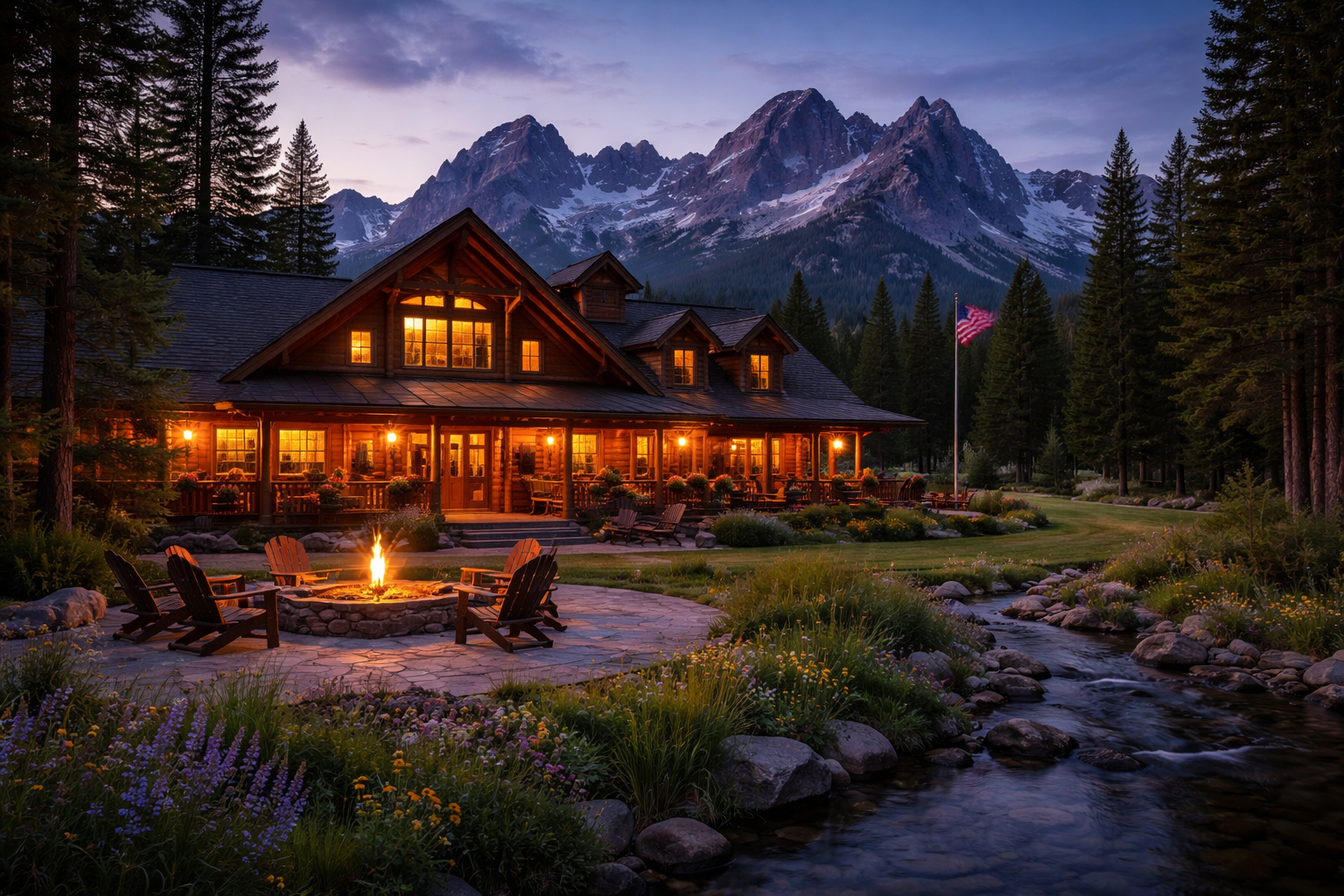
The rest of the journey would enlarge that impression. The mountains would give it vertical scale. The hot springs would teach him Idaho’s tempo. The food would show him that appetite here could remain honest. The wildlife and weather would remind him that the state still answers to realities larger than convenience. Yet the seed was planted in the first look. Idaho struck him as a place with inner form. He has learned to trust that signal.
Why First Impressions Matter Here
In some states, the first impression is a decoy. It promises one thing and then reveals another, often thinner reality underneath. Idaho works differently. Its first impression is incomplete, but not false. The calm is real. The reserve is real. The room is real. What changes is not their truth, but their depth. The traveler comes to understand that these qualities are not incidental style choices. They are structural features of the state’s identity.
This is why Hiro’s first sight deserves its own story. It was not a thunderclap moment, not a cinematic conversion, not one of those travel-writer inventions in which a life is divided neatly into before and after by the appearance of a mountain. It was more intelligent than that. He saw a place that did not confuse itself. He saw a place capable of quiet dignity. He saw, before he had language for it, that Idaho was not trying to become somebody else’s idea of the West.
That is a tremendous thing to see first. It meant that everything to follow would be interpreted through respect rather than condescension, through curiosity rather than premature certainty. Hiro first sees Idaho, and what he really sees is a state secure enough to begin slowly. The traveler who notices that is already, whether he knows it or not, on the right path.