

He first understood this in Boise, though at the time he would not have used the word understood. He would have said only that he liked the place more than he expected to. There was a quality to the evening that felt composed rather than performed. The capitol light settling into stone. The streets still civilized enough to invite walking. The feeling that a city could be modest without being apologetic. Hiro, who had spent enough time in larger and louder American places to know the usual choreography of self-advertisement, noticed Idaho’s refusal to push. Boise did not beg to be admired. It simply allowed admiration to arrive.
That set the tone for the rest. Idaho did not announce itself in a single grand thesis. It accumulated. A river path. A hotel window. A breakfast served without theatricality. The smell of pine in the hour before the day properly commits to itself. A conversation that did not try too hard. Hiro came to feel that Idaho had a rare social grace: it left room around things. Around people, around landscapes, around silence. It did not confuse emptiness with lack. It understood, in a way some more aggressively marketable states do not, that room itself can be a luxury.
What held on to Hiro was not only Idaho’s beauty. It was Idaho’s manners.
That word may sound odd in a story about mountains, rivers, hot springs, and dark skies. But manners are not trivial. Places have them just as people do. A place may be overfamiliar, self-conscious, overdecorated, needy, loud, eager to dominate the relationship. Idaho was none of those things. Idaho kept a certain reserve. It did not open all at once. For Hiro, who had learned by now that reserve and depth often travel together, this was not a flaw. It was the beginning of trust.
Why the Sawtooths Stayed
There were, of course, the obvious images. The Sawtooths at sunrise. The alpine lake holding a perfect version of the peaks until a ripple gently ruined the illusion. Stanley in that twilight register where lodge windows glow more warmly because so much of the surrounding world has already gone blue. These were scenes designed, one might think, to become memory. Yet the reason they remained with Hiro was not simply because they were beautiful. He had seen beautiful mountains before. He had seen lakes worthy of reverence before. What made Idaho different was the emotional temperature of the encounter.
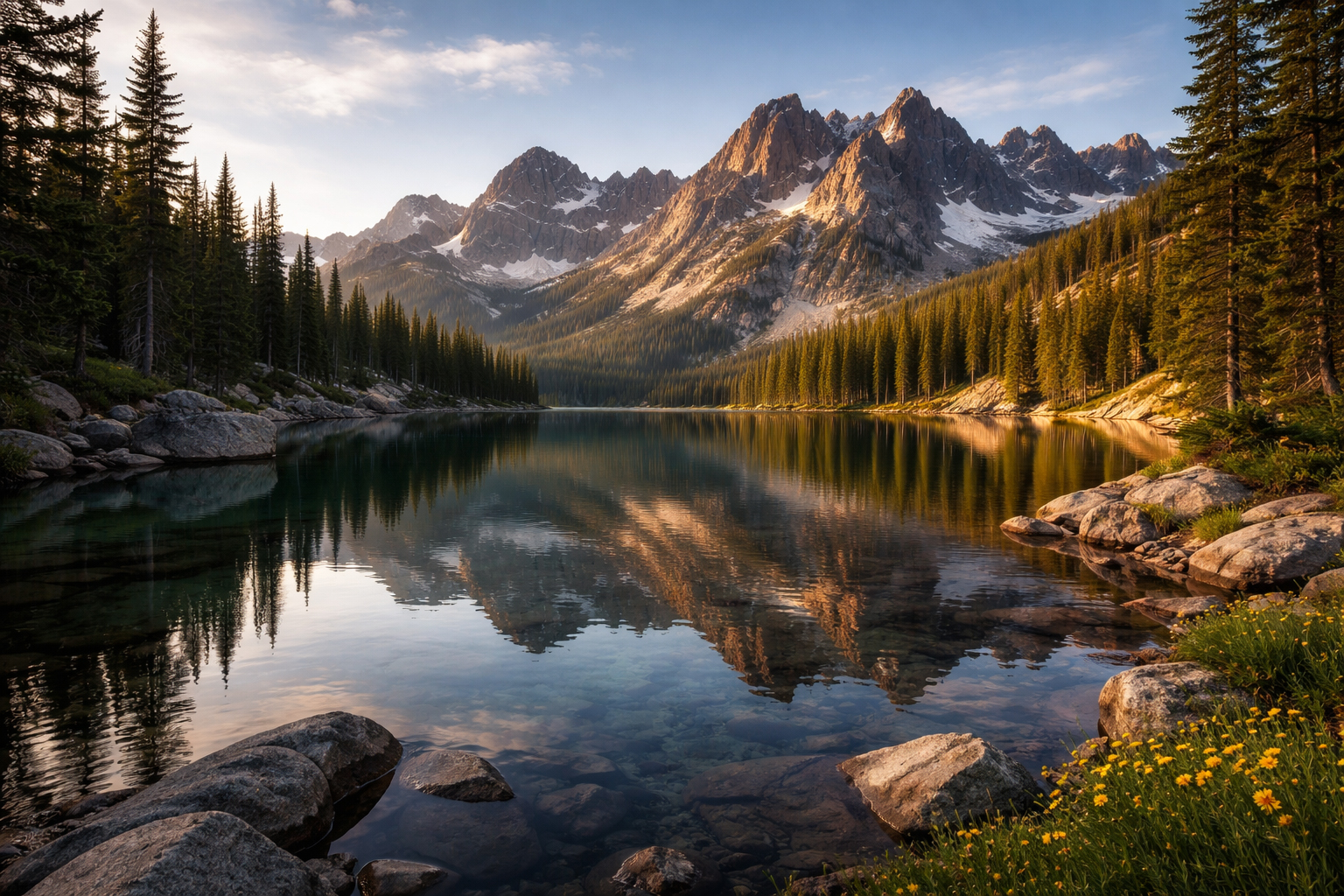
The Sawtooths did not make him feel small in the cheap, tourist-poster sense. They made him feel accurate. There is a difference. Some grand landscapes induce a kind of temporary emotional inflation: one feels heightened, enlarged by the fact of having witnessed them. Idaho worked differently. It reduced the noise. It sorted priorities. The mountains did not bestow drama so much as order. Hiro left those mornings with the peculiar sense that his thoughts had been cleaned.
That sensation became one of the abiding Idaho memories. Not thrill, exactly. Not conquest. A form of reorganization. He began to suspect that the state’s deepest beauty lay not in its ability to stun but in its ability to restore proportion. It returned objects and feelings to their proper size. A breakfast tasted better after cold air and clear water. A conversation felt more substantial after a long quiet drive. Even pleasure seemed to carry more dignity here because it had not been over-scripted in advance.
Luxury Without Noise
Sun Valley sharpened the point. Hiro is no enemy of comfort. He appreciates fine hotels, good lighting, warm service, a drink set down with assurance rather than fuss. He has been enough places to know that luxury often mistakes itself for excitement. It piles on signals. It worries that without a certain excess the guest will fail to notice how privileged the experience is meant to be. Idaho’s version was far better. In Sun Valley and in the quieter corners of the state’s hospitality world, he found something rarer: luxury without noise.
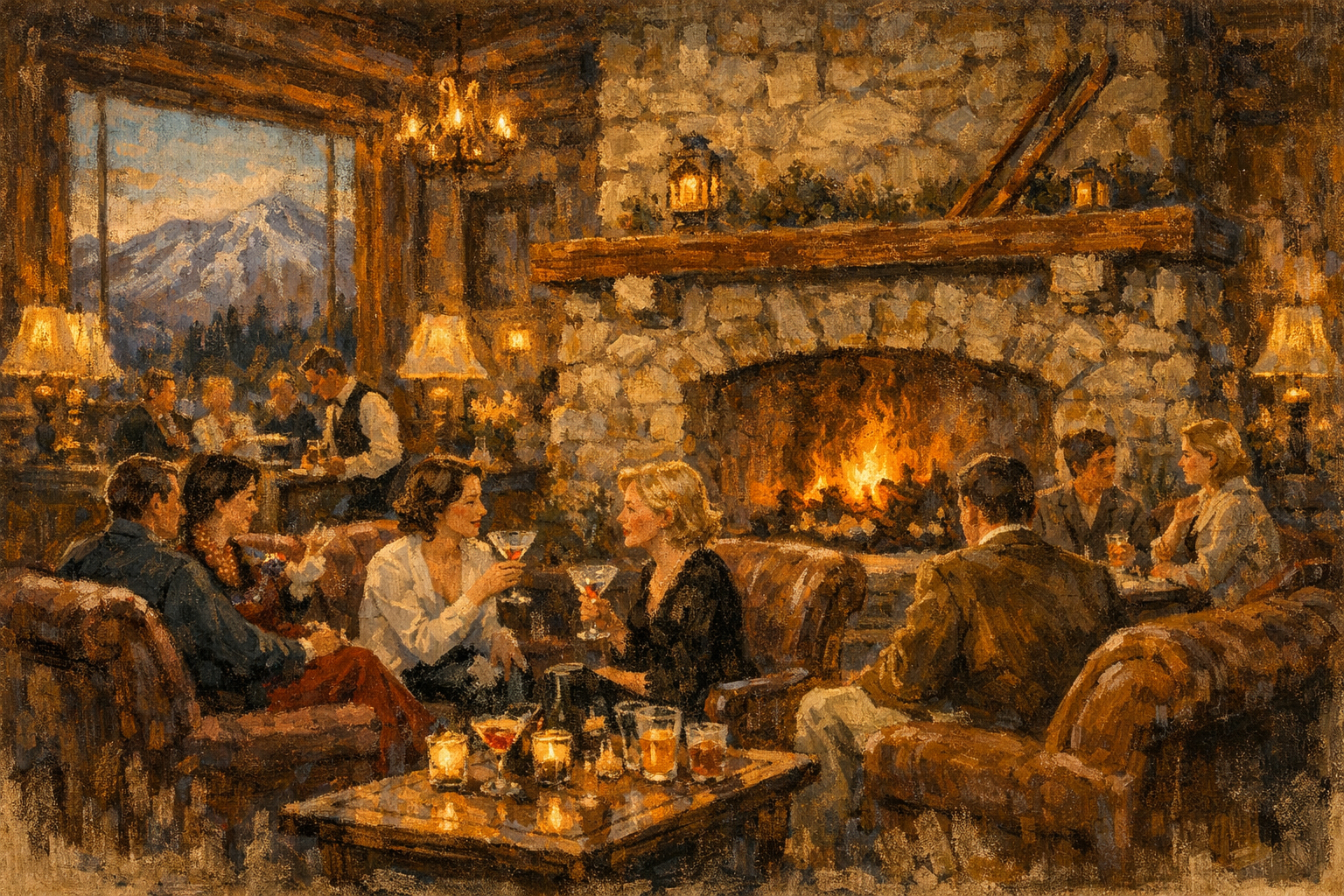
A fireplace, properly lit. A chair that asks you to remain in it. A cocktail that tastes less like branding than judgment. Snow outside or aspens beyond the glass. The simple reassurance that one has arrived somewhere both cultivated and still answerable to weather. This mattered to Hiro because he had grown tired of destinations that sealed themselves off from their own landscape. Idaho’s better interiors remained in conversation with the outdoors. Warmth here felt earned. Shelter felt meaningful because the world beyond the window still possessed a little authority.
This, too, was part of what held on to him. Idaho allowed refinement without severing it from reality. The state did not need to choose between taste and terrain. It did not need to prove sophistication by pretending it had outgrown the mountain, the river, the ranch road, the changing sky. It simply folded those things together. Hiro found that deeply attractive. It suggested a state secure enough not to fake another identity.
The Water, the Steam, the Slow Hours
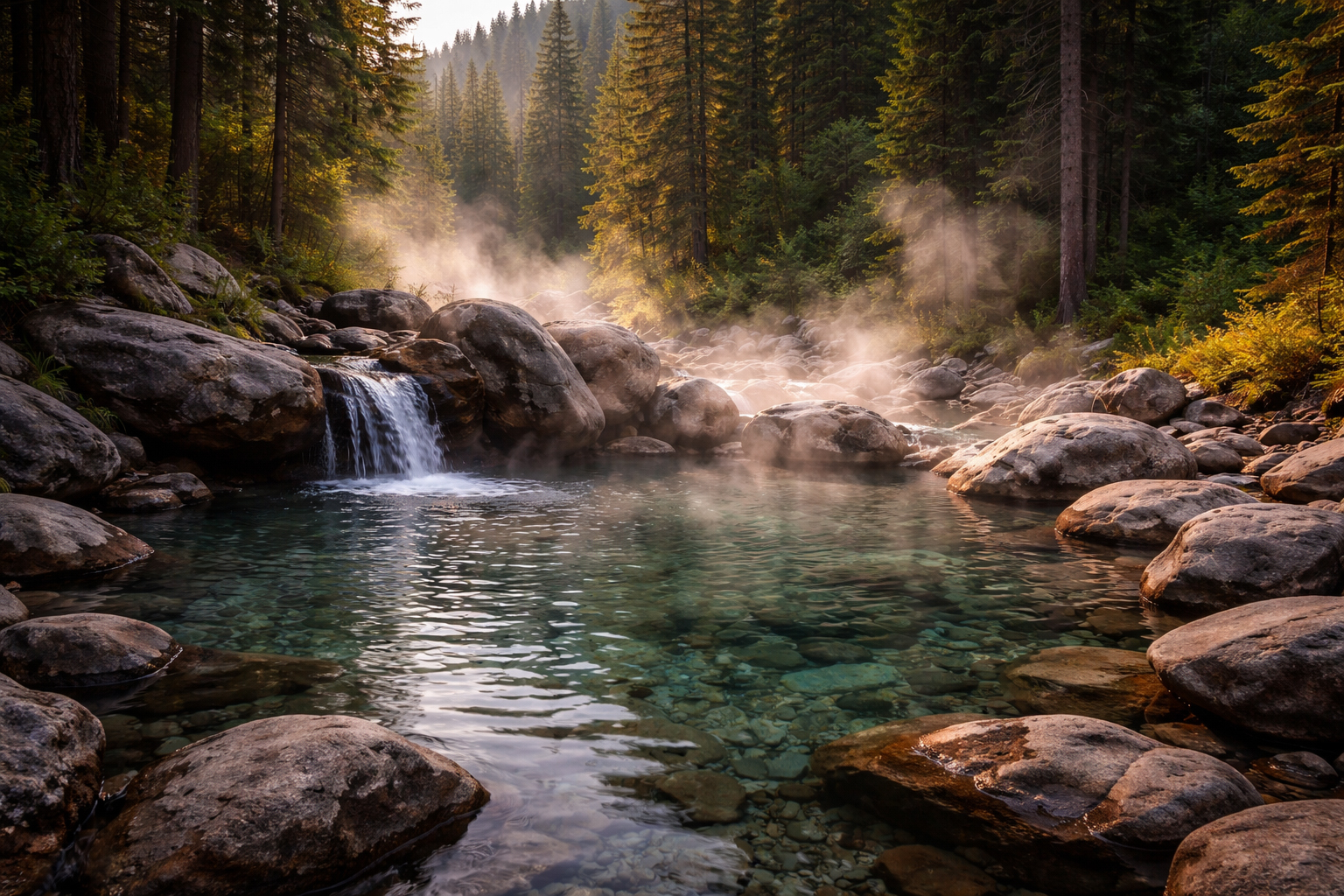
Then there were the hot springs. Any state can advertise mineral water and scenic soaking, but Idaho’s springs belong to a larger philosophy of time. Forest steam at morning. Winter soak with snow held along the edge of stone. The body entering warmth while the air remains exacting. Hiro understood quickly that these were not merely recreational experiences. They were lessons in tempo. Idaho was telling him, again, to stop rushing beauty past itself.
He had, by this point, begun to notice that Idaho was changing his sense of duration. In many places, one asks what there is to do next. In Idaho, the more interesting question was whether one had finished absorbing where one already was. A river overlook did not need immediate replacement by another attraction. A meal did not need an unnecessary sequel. A good morning was sufficient drama for several hours. This is a difficult art for modern travelers, who have been trained to consume experience in a sequence of highlights. Idaho encouraged a more mature appetite. It suggested that if something is good, one may remain with it.
Why Coeur d’Alene Felt Different
Coeur d’Alene offered another version of the state’s hold. Lakeside places often risk becoming either over-polished or aggressively casual. They lean too hard into resort identity or else try to flatter guests with a performance of effortless leisure. What Hiro found there was something more balanced: water large enough to quiet the ego, hospitality polished enough to reassure without becoming gaudy, and a sense that the whole experience had been calibrated to the actual emotional effect of being by a northern lake at day’s end.
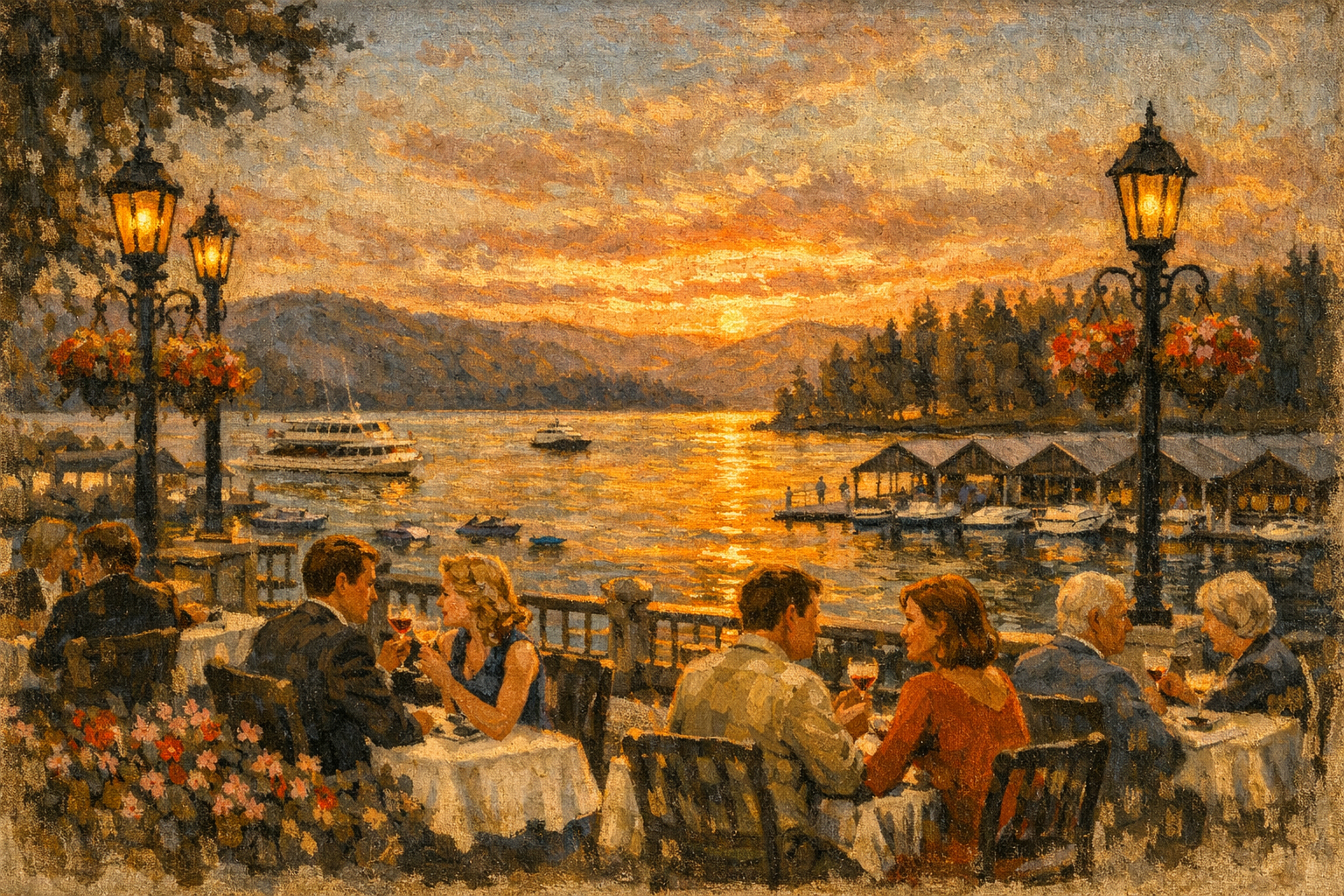
He remembered not just the views, but the way people sat with them. Idaho, unlike some places, did not seem embarrassed by stillness. One could have a table by the water and not be hurried into treating it as content. One could watch light leave the lake and feel that this was, in fact, the evening’s central event. For Hiro, who has always believed that the best travel teaches a person how to receive rather than merely how to acquire, this mattered tremendously.
It is one reason the state remained after he left. Idaho did not simply give him scenes. It taught him a disposition. Pay attention. Loosen your grip. Allow the mountain to be a mountain and the lake to be a lake. Resist the reflex to narrate everything too quickly. Let the day finish speaking before you decide what it meant.
The State That Does Not Overexplain Itself
There is, finally, a philosophical reason Idaho held on to Hiro. The state resists total explanation. This is one of its great strengths. Some places become less interesting the moment you believe you understand them. Idaho grows more interesting after that moment, because the first understanding is usually superficial. You arrive imagining a western state of mountains, rivers, cold mornings, civic modesty, potatoes if one insists, perhaps a little frontier romance. Some of that is true. But the longer one pays attention, the more the state begins to separate itself from the cliché assembled in advance.
Idaho is more refined than outsiders imagine, but less eager to advertise refinement than they expect. It is more inward than spectacle-driven states, but not closed. It is more emotionally articulate in its landscapes than many heavily praised destinations, but its vocabulary is not one of self-display. It believes in clarity rather than announcement. For Hiro, who has become increasingly suspicious of places that market themselves too completely, this restraint was not only charming. It was trustworthy.
That trust is what remained. After he had gone home, after the photographs had been stored and the pleasant fatigue of travel had worn off, Idaho kept returning at odd hours. In a particular kind of morning light on another trip. In the sight of steam against cold air. In the memory of a meal that had not tried too hard. In the realization that the best destinations are not necessarily the ones that dominate the traveler’s imagination in real time. Sometimes they are the ones that continue, quietly, to compose it afterward.
What Idaho Kept
It kept his attention, to begin with. Then it kept his standards. After Idaho, certain forms of excess began to look unnecessary. Certain kinds of overbranding began to seem childish. He wanted more room around things. More air in a day. More authority in a landscape. More honesty in comfort. More places that understood the difference between grandeur and shouting. Idaho had reset the scale.
And perhaps that is the truest meaning of the title. The Idaho that holds on to Hiro is not just the Idaho he remembers. It is the Idaho that changed the shape of what he now seeks. A morning that begins cold and clear. A city that does not mistake modesty for weakness. A mountain that organizes the mind. A lake that does not need a speech. A hotel that knows warmth is a form of intelligence. A state that trusts its own character enough to leave part of itself unsaid.
That is what stays. Not a slogan. Not an itinerary. A calibration. Idaho remains with Hiro because it taught him how much more beautiful a place can become once it stops trying to seize him all at once. It held on by not clutching. It persuaded by not pleading. Long after louder states had faded, Idaho was still there, calm and exacting, asking only that he remember properly.