
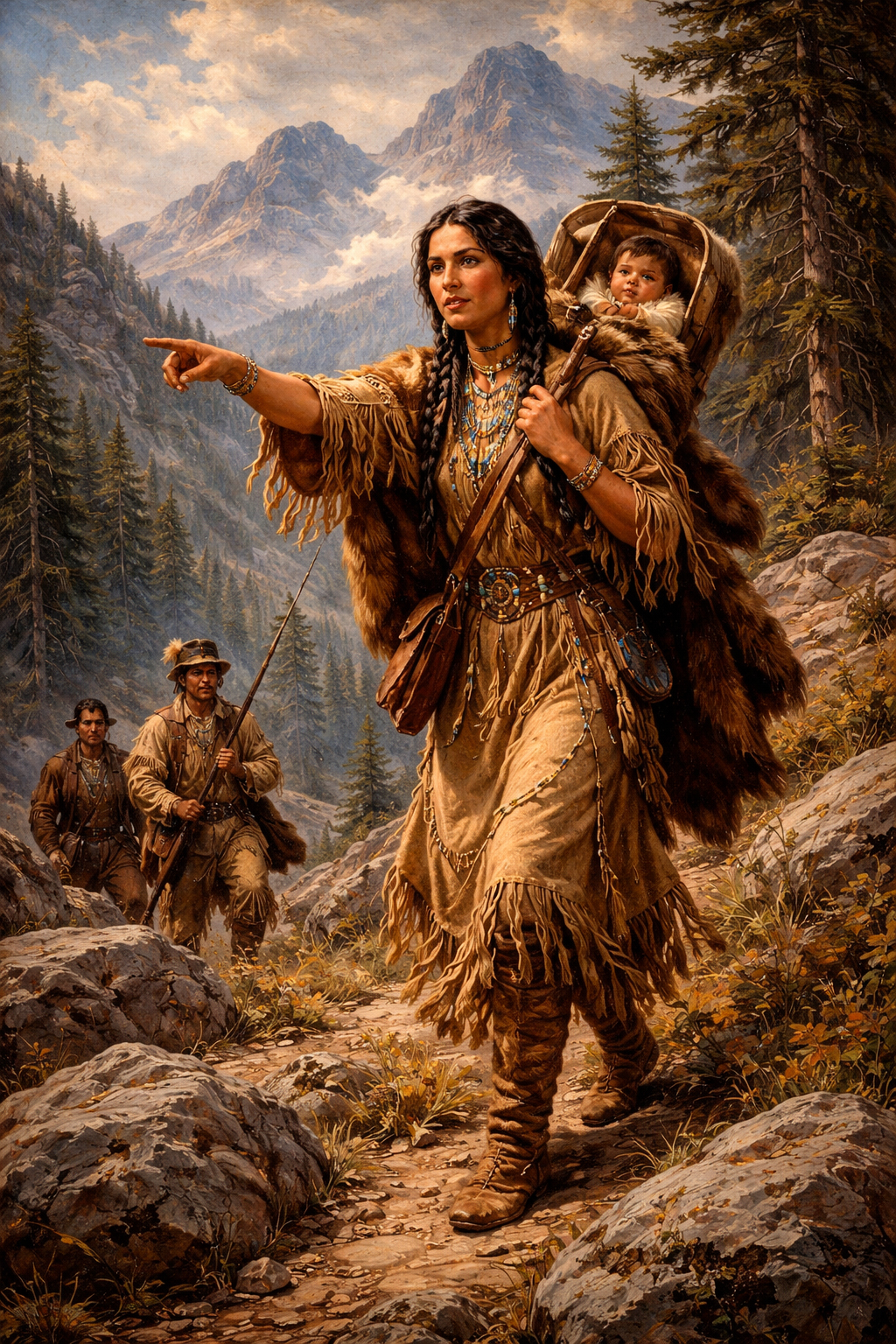
There are historical figures who become famous because they made speeches, signed documents, commanded armies, or built institutions with their own names attached. Sacajawea entered American memory differently. She entered it through movement. Through proximity. Through the difficult, under-described labor of being present at the right moment with the right knowledge in a world where misunderstanding could become disaster. This is one reason her story remains so compelling. It reveals that history is not only made by official authority. It is also made by those who carry indispensable human knowledge across uncertainty.
For Idaho, Sacajawea matters not as a decorative historical emblem but as a figure of origin. Her Lemhi Shoshone connection places her inside one of the deepest layers of the state’s human story. Long before Idaho was a territory or a state, before its rivers were converted into maps and its passages into routes of national ambition, it was homeland. That is the first truth any serious Idaho history must honor. Sacajawea’s life, however difficult and partially obscured by the record, reminds us that the famous western passage was never through empty land. It was through inhabited intelligence.
Sacajawea does not merely appear in the story of the passage. She changes what the passage means.
That change is partly practical and partly moral. In practical terms, her role in helping the expedition reconnect with the Lemhi Shoshone and secure horses for the mountain crossing has long been understood as crucial. But practical usefulness alone is too thin a description. Her presence altered the texture of encounter. She signaled something other than war. She embodied connection where the expedition might otherwise have represented only intrusion. This does not make the larger American enterprise innocent. It makes the human situation more complicated, and therefore more truthful.
The Problem of the Easy Legend
Sacajawea has been badly served by easy admiration. She is so revered in the abstract that the actual force of her life is often softened. The sentimental version of her story emphasizes loyalty, courage, womanly grace, and maternal symbolism. Some of this is not false, but it is insufficient. It domesticates a figure who deserves to be treated with greater historical seriousness. She was not simply a reassuring female presence on a masculine expedition. She was a young Indigenous woman whose life had already been shaped by displacement and whose knowledge became decisive in a moment of imperial movement through the West.
The easy legend also tends to absorb her too completely into the story of the United States, as if her meaning begins only when the expedition arrives. Idaho offers a corrective. From an Idaho perspective, Sacajawea does not enter history when the Corps of Discovery notices her usefulness. She already belongs to a world with its own geography, kinship, memory, and mountain intelligence. The expedition becomes important partly because it collides with that world.
This is why her Idaho meaning remains so strong. She asks the state to think older thoughts. She reminds Idaho that the mountains were not first scenic assets or territorial prizes. They were lived space. The passage through them was not simply exploration. It was encounter, dependence, and translation under pressure. Through Sacajawea, Idaho becomes not a blank western stage but a homeland through which national history had to pass.
The Passage Itself
Passages make for good national mythology because they imply direction, destiny, and accomplishment. One crosses. One endures. One reaches the other side. But actual passages are more humiliating and more interesting than that. They involve hunger, wrong turns, weather, misjudgment, and the need to rely on people whose knowledge official narratives rarely know how to center properly. The mountain passage associated with Sacajawea belongs to that harder category. It was not a triumphant glide through dramatic scenery. It was a test of limits.
What Sacajawea carried into that test was not only language or identity, but relational authority. She occupied the space between worlds in a way no formal chain of command could replicate. This is why her role continues to exert such power over the imagination. She represents a form of indispensable agency that is neither wholly official nor incidental. She did not command the expedition, yet the expedition’s hopes moved through conditions in which her presence mattered profoundly.
That is a kind of authority modern readers understand better than earlier commemorations did. We have become more interested in networks, translation, mediation, and the human infrastructures beneath famous decisions. Sacajawea stands near the center of that recovered historical vision. She makes visible the truth that large enterprises depend on knowledge they often fail fully to honor.
Idaho’s Older Intelligence
What exactly does Sacajawea symbolize for Idaho? Not merely courage, though courage is there. Not merely guidance, though guidance is there too. She symbolizes older intelligence. The kind tied to place, relation, survival, memory, route, and season. Idaho, in the contemporary imagination, is often represented through its striking landscapes and self-reliant temperament. Sacajawea adds a more foundational layer. She reminds the state that intelligence here was Indigenous before it was administrative, mapped, or promoted.
This matters because identity without memory becomes branding. A serious Idaho magazine cannot be satisfied with branding. It has to ask where the state’s deepest forms of knowledge begin. Sacajawea is one answer. Not the only one, certainly, but one of the most luminous. Through her, the state can remember that movement through Idaho always required interpretation, and that interpretation was human before it was cartographic.
Before Idaho was known by lines on paper, it was known by people who could move through it without fiction.
That sentence helps explain why Sacajawea remains far more than a national icon attached to monuments and schoolbooks. In Idaho she is tied to actuality. To rivers, valleys, kin, mountains, crossings, and the reality that the expedition needed something the land’s existing people already possessed. Her significance becomes sharper when placed back into that material frame.
Woman, Mother, Figure of Passage
The image of Sacajawea carrying her infant has become nearly inseparable from her public memory. It is a powerful image, and not wrongly so. It emphasizes endurance, continuity, and the strange juxtaposition of domestic life with continental movement. Yet even here caution is needed. Maternity has often been used to soften women into symbols of reassurance rather than to sharpen the complexity of their experience. Sacajawea carrying a child through such circumstances is not simply a tender image. It is a severe one. It measures the conditions of the journey against the persistence of life itself.
Seen this way, she becomes even more extraordinary. Not because she fits a comforting national allegory, but because she does not. She remains difficult to classify. Indigenous, displaced, young, maternal, strategic, remembered, misremembered. She is at once intimate and historic. This is one reason her story has survived so forcefully. It occupies several symbolic registers at once and never becomes reducible to any single one of them.
For Idaho, that irreducibility is a gift. States too often prefer figures who can be made simple. Sacajawea insists on a richer style of remembrance. She makes Idaho’s story more intelligent by making it less tidy.
Why She Endures
Sacajawea endures because she belongs simultaneously to public myth and to the critique of public myth. She is honored widely, yet the more carefully one studies her, the more one sees how much the nation has wanted from her image: legitimacy, softness, heroism, mediation, feminine grace, western destiny. The hunger for symbol has been enormous. And still the person does not disappear. She keeps returning through the facts that remain stubborn: Lemhi Shoshone, movement, translation, mountain passage, indispensable presence.
There is another reason for her endurance. She allows Americans to glimpse a truth they often prefer to obscure: the republic’s movement westward was never self-sufficient. It depended on existing knowledge, existing peoples, and relationships it did not fully control. Sacajawea personifies that dependence. She stands inside the grand national narrative as a reminder that the narrative required help from those it would later too often marginalize.
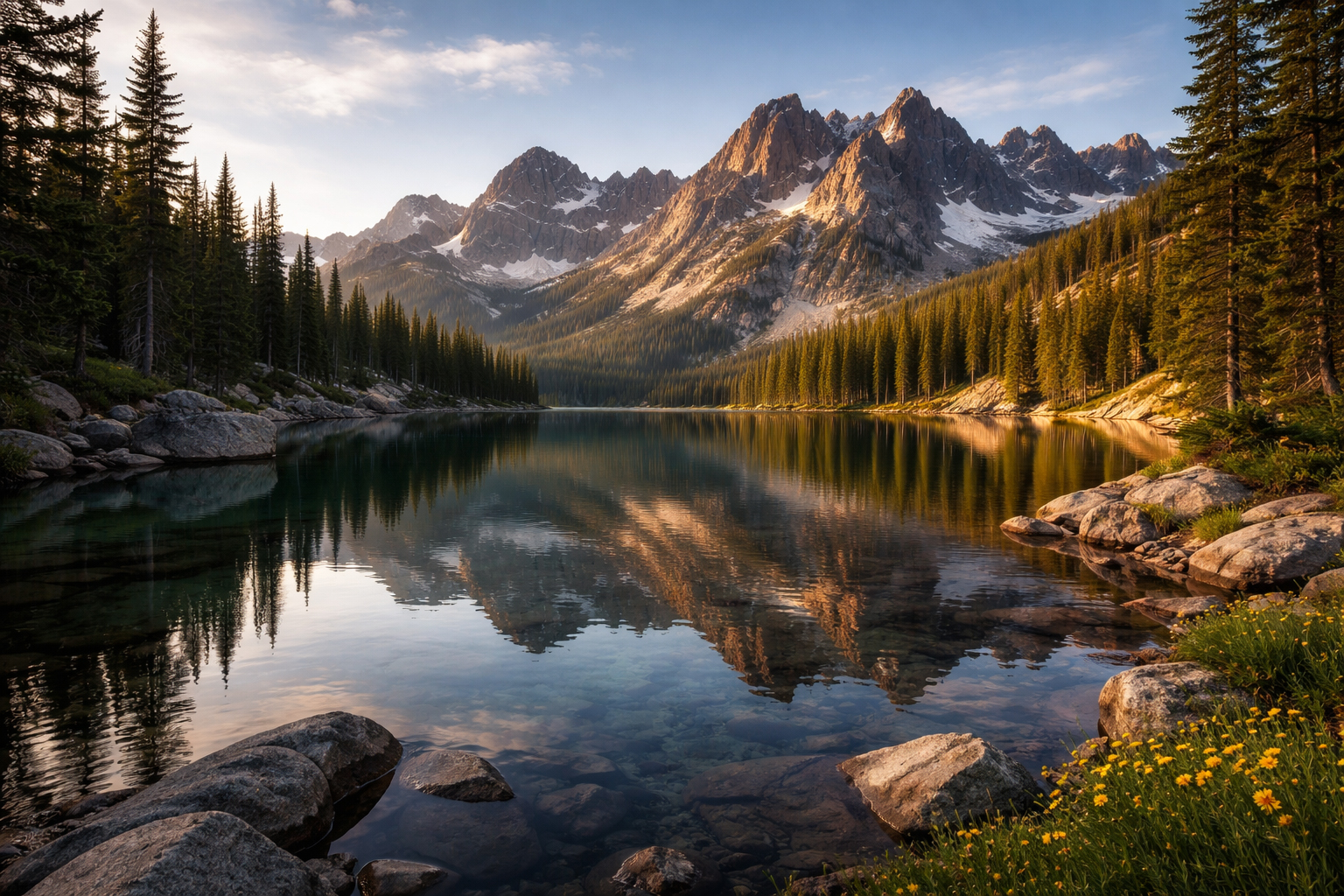
In Idaho, this truth is not abstract. It is geographic. The state’s rivers, valleys, and mountain passages make the point concrete. They teach humility to anyone willing to read them seriously. Sacajawea belongs to that humility. She is one of the figures through whom Idaho asks to be understood not merely as dramatic landscape, but as old inhabited reality.
The Passage Continues
It is tempting to conclude such an essay by saying that Sacajawea “bridges worlds,” but even that familiar phrase risks becoming too smooth. Bridges suggest stable structures between fixed points. Her life was harsher and more contingent than that. Passage is the better word. Passage involves uncertainty. It involves movement without guarantee. It involves the need to trust knowledge that may not yet have been honored properly. Sacajawea and the mountain passage: the title holds because both terms remain active. She is not just in the passage. She is part of what passage meant.
That is why she belongs so centrally to Idaho’s human gallery. She gives the state depth, age, gravity, and a corrected sense of origin. She insists that the story begins earlier than the state itself, and that the most famous movement through Idaho depended on someone who already belonged to the land in a more meaningful way than the explorers ever could.
Sacajawea remains one of the great Idaho figures because she changes the terms of remembrance. She asks the state to honor not only courage, but prior knowledge; not only westward ambition, but Indigenous presence; not only the crossing, but the people without whom the crossing would have meant something very different. In that sense, the mountain passage is still not over. Idaho is still learning how to tell it correctly.