
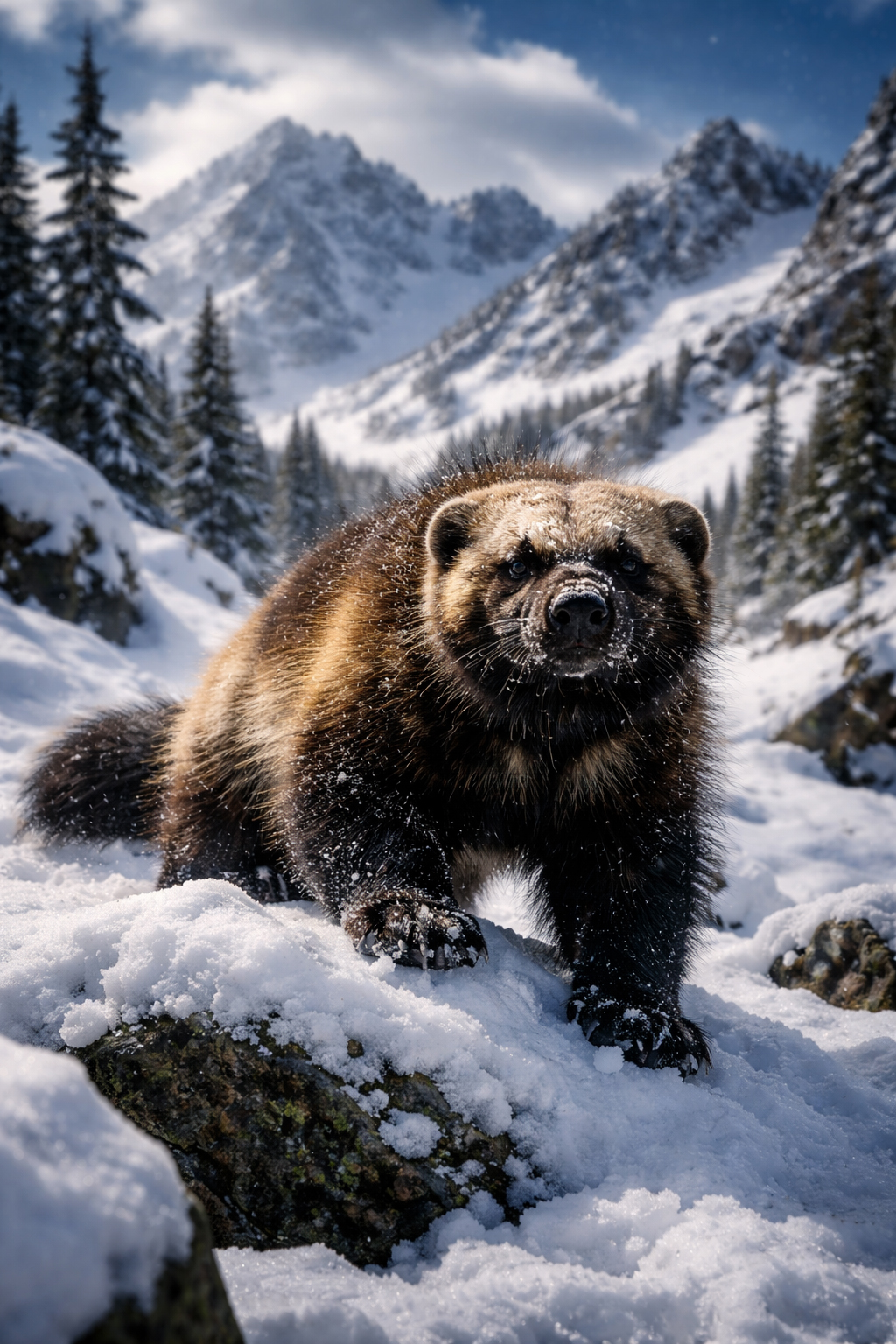
The wolverine has always enjoyed a reputation larger than its body. This is partly because it inspires the right kind of exaggeration. Not nonsense, exactly, but an enlargement of moral scale. People describe it as relentless, fierce, stubborn, unembarrassed by cold, and somehow more severe than the mountains that contain it. Such descriptions are imperfect, but they arise for a reason. The wolverine seems to carry a form of wildness stripped of ornament. It is not majestic in the usual sense. It is harder than that.
That hardness matters in Idaho, where the most serious landscapes are not the easiest to sell. The postcard Idaho of lakes, lodges, and sunrise peaks is real enough. But there is another Idaho behind it: snowbound ridges, broken winter country, deep timber, old drifts, places where appetite and confidence are tested by exposure and where beauty has not been softened for human comfort. The wolverine belongs to that second Idaho. It is one of the creatures that keeps the state from becoming too decorative in the national imagination.
The wolverine gives Idaho one of its sternest truths: the mountains are not only beautiful. They are selective.
This is why the animal feels so symbolically potent. It is not simply rare. It is diagnostic. Its presence indicates a kind of country still severe enough to sustain a life defined by independence, range, and cold-weather tenacity. To imagine a wolverine in Idaho is to imagine the state at one of its least domesticated settings. The creature widens the emotional meaning of the map.
The Animal of the Harsh Register
Every state has a softer self and a harder one. Idaho’s softer self is easy to recognize: fly-fishing calm, mountain hospitality, alpine reflection, western ease burnished by luxury and distance. The harder self is the one that answers to winter, remoteness, and the limits of the human body. The wolverine belongs decisively to that harder register. It does not soothe. It clarifies.
Part of the clarification comes from proportion. The wolverine is not the largest animal in the mountains, nor the fastest, nor the most visually glamorous. Its power comes from attitude, environment, and the strange compression of strength into an animal that seems all intention. It feels distilled. There is very little excess in it. Fur, muscle, will, cold tolerance, movement through difficult country. Nothing ornamental. Nothing unnecessary.
That economy of design is one reason the wolverine feels so compelling in a state like Idaho. The state’s better virtues have similar economy. Competence matters. Fuss does not. Showmanship matters less than endurance. A person or creature that can move through hard conditions without self-dramatization tends to command respect here. The wolverine fits that ethic, albeit in a far more feral form.
Snow Country Intelligence
The wolverine’s great symbolic environment is snow. Snow here does not mean postcard weather or festive atmosphere. It means persistence, depth, isolation, and the remaking of terrain according to winter logic. The animal belongs to places where snow is not a passing condition but a governing one. That changes everything. Routes alter. Prey shifts. Movement becomes tactical. The mountains sort living things according to seriousness.
This is where the wolverine begins to feel almost like an intelligence of the snow itself. It does not merely endure winter; it reads it. It turns conditions that would defeat easier creatures into the terms of its ordinary life. That ability is one of the reasons human admiration for it carries a hint of fear. The animal seems to know a version of the mountains inaccessible to us except in fragments.
A wolverine in snow does not look picturesque. It looks correct.
Correctness, in this case, is more important than beauty. The animal appears fitted to the mountain winter with such conviction that the landscape starts to seem defined by that fit. We often think of scenery first and wildlife second, as though animals enter the frame later. The wolverine reverses the order. It suggests that the snow country may have always been waiting for something exactly this severe to inhabit it properly.
Why Elusiveness Matters
Like the woodland caribou, the wolverine gains some of its force from rarity. But the two animals are rare in different emotional ways. The caribou feels spectral, quiet, almost melancholy in its elusiveness. The wolverine feels withheld rather than ghostly. It is not absent in a mournful sense. It is simply not ours. That distinction is crucial. The wolverine does not seem like a fading memory of wilderness. It seems like wilderness reserving part of itself beyond our easy reach.
This is one reason the animal has such value for Idaho’s deeper identity. It keeps the state from becoming too fully consumed by visibility. Not everything meaningful can be turned into encounter, itinerary, or content. Some things remain powerful precisely because they continue to exist at the edge of human access. The wolverine is one of Idaho’s best examples of that truth.
In an age obsessed with access, this feels almost radical. The wolverine represents a kind of ecological privacy. It is not performing wildness for us. It is conducting its own hard business in the mountain margins. The result is a more serious kind of admiration, one that includes humility.
The Mountain Without Sentiment
Americans are fond of sentimental mountains. We project healing, transcendence, and noble solitude onto high places with alarming efficiency. Idaho can support those readings, but not only those readings. The wolverine returns the mountain to a sterner condition. It reminds us that altitude is not inherently therapeutic. Snow does not care whether we find it beautiful. Wilderness is not obliged to become a metaphor for our emotional refinement.
This is an important correction. Idaho’s strongest landscapes become more interesting when they are allowed to retain their hardness. The wolverine is one of the creatures that enforces that permission. It says: there is more here than scenic reward. There is selection, winter judgment, and an older appetite for survival than the visitor usually brings with him.
That, too, is why the animal works so well editorially. It gives us a way to speak about Idaho without softening the state into pure amenity. It gives the mountains claws without turning them into melodrama.
Snow Shadow of the Mountains
The title chooses shadow for a reason. The wolverine is not simply a resident of the peaks. It feels like the dark extension of them, the instinctive counterpart to their visible grandeur. A peak under fresh light may invite admiration; the wolverine asks what survives there after admiration leaves. It inhabits the after-hours of the mountain imagination—the colder, lonelier, more exacting version of alpine life.
Idaho needs that shadow if it wants a complete self-understanding. A state made only of golden dawns and curated western comfort would be less true and far less interesting. The wolverine preserves the unsmoothed part. It says that the mountains do not merely inspire. They also test. That some of the state’s finest creatures are not friendly ambassadors but difficult presences. That wilderness retains a moral edge when one allows it to.
The wolverine matters because it keeps Idaho honest about its mountains.
What the Animal Gives the State
So what does the wolverine give Idaho, finally? Not familiarity. Not comfort. Something better. It gives the state a fiercer dignity. It enlarges the winter country. It reminds readers that Idaho’s uniqueness lies partly in the animals that do not turn themselves toward us. It strengthens the state’s claim to seriousness by embodying one of its least negotiable truths: that the finest country is often the country that remains hard.
Wolverine: snow shadow of the mountains. The phrase works because the animal belongs to Idaho as a shadow belongs to a peak—drawn from the same structure, darker than the visible line, and necessary if the shape is to be understood completely. Without it, Idaho would still be beautiful. With it, Idaho becomes deeper, colder, and more exact.